








Some open world games give players huge maps. They may have wide fields, tall mountains, long roads, large cities, forests, deserts, and many small areas to explore. On paper, these worlds seem full of content. Yet, after a few hours, the player may feel that the map is strangely empty.
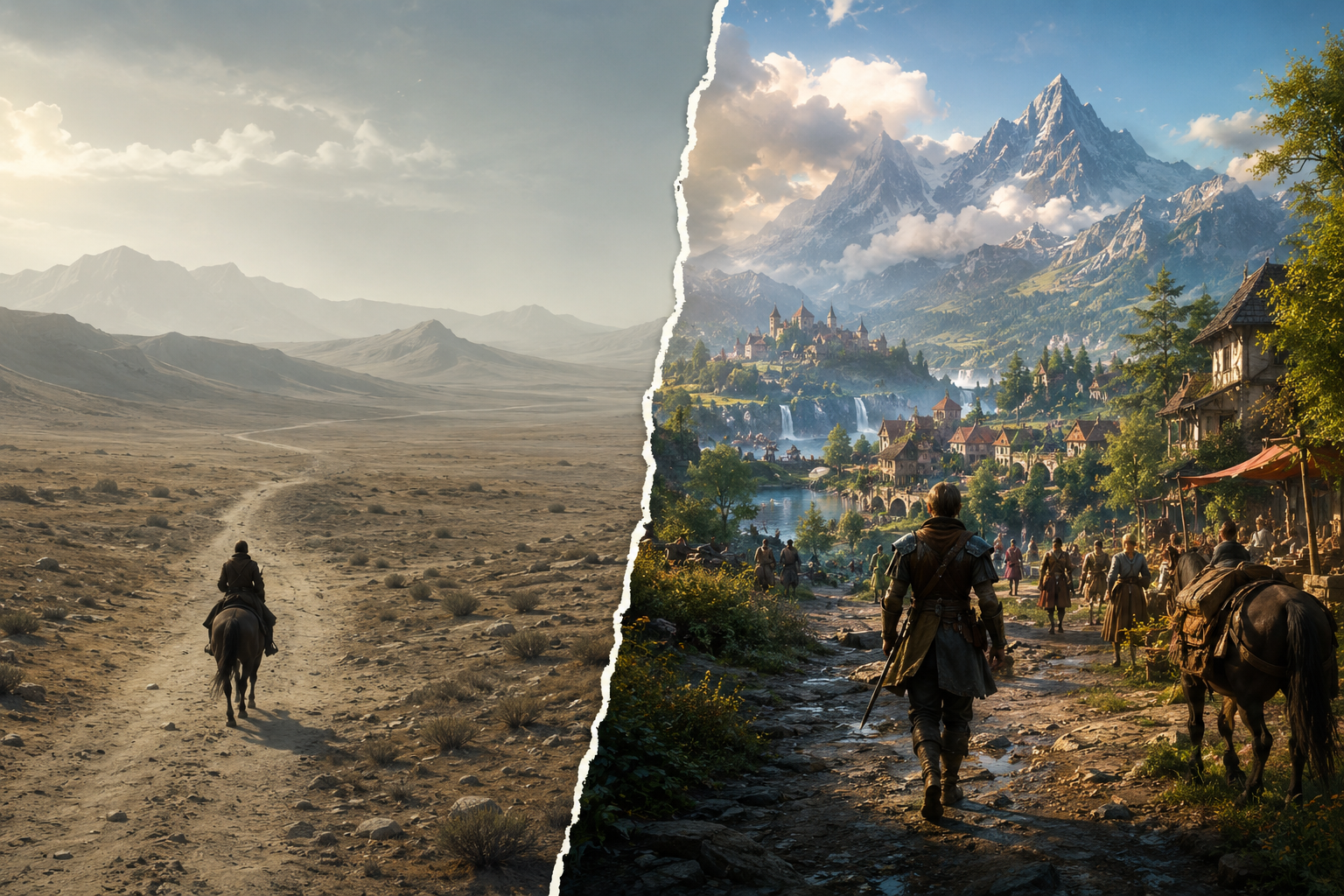
This happens because map size and world density are two different things. A map can be very large but still have very little that feels useful or meaningful. Another game can have a much smaller map and still feel rich because there is always something worth seeing, doing, or understanding.
Players do not judge a world only by its size. They judge it by how much the world gives them a reason to care.
Distance Alone Does Not Create Adventure
One of the biggest problems comes from long travel times. A game may place two objectives many minutes apart. The road between them may have little more than trees, rocks, grass, and a few empty buildings.
At first, this can make the world feel large. After some time, however, the same long trips can become tiring. The player starts to see travel as a delay rather than part of the adventure.
A large world works best when distance has a purpose. A road can lead to a strange house. A mountain can hide a secret path. A quiet field can become the place where a rare event takes place. Even a simple trip can feel useful if the player has a reason to pay attention.
Without such reasons, a huge map can feel more like a long hallway.
Beautiful Scenery Is Not Always Enough
Modern games can create amazing landscapes. A player may see huge mountains, deep rivers, old castles, busy roads, and detailed forests. These sights can create a strong first impression.
But beauty alone does not always make a world feel alive.
Imagine a huge mountain in the distance. It looks great, but the player cannot climb it, find anything there, or use it in any meaningful way. After a while, that mountain becomes part of the background.
The same idea applies to buildings. A town may contain hundreds of houses, but if most doors stay closed and the people inside have no purpose, the town can still feel empty.
Good world design gives scenery a role. A place should not only look good. It should also make the player wonder what happened there or what they can do there.
Repetition Can Make A Large World Feel Small
A large map often uses repeated content. This is normal because it would be extremely hard to create every location from scratch. The problem starts when players notice the pattern too easily.
If every enemy camp has the same layout, the same type of enemies, and the same reward, the player soon stops feeling curious. The same happens with repeated houses, caves, puzzles, shops, and side tasks.
The map may still be enormous, but the player’s mental picture of it becomes much smaller.
This is why variety matters so much. A game does not need every location to be completely different. It only needs enough change to keep the player unsure about what may come next.
A strange cave can be more memorable than ten normal caves.
Things To See Are Different From Things To Do
This is one of the most important differences in open world design.
A world may contain thousands of objects, but many of them exist only for decoration. Trees may sway. Birds may fly. Buildings may have detailed walls. Cars may fill a road. Yet the player may have no meaningful way to interact with most of these things.
A rich world gives players choices. They can enter places, discover secrets, speak with people, solve small problems, find new paths, or change what happens in an area.
This does not mean every object needs a special purpose. Instead, the world needs enough useful interactions to make the player feel that their actions matter.
The question is not, “How much stuff is on the map?”
The better question is, “How many things can make the player curious?”
NPCs Help A World Feel Alive
People inside the world also have a huge effect on how players feel about a place.
If every NPC stands in one spot and repeats the same line, the player quickly understands that these people are not really part of the world. They exist only to provide information, shops, or quests.
Simple behavior can change this. People who travel between places, go to work, meet friends, react to danger, or change their actions at different times can make the same town feel far more real.
The player does not need a complex simulation for every person. Small signs of daily life can be enough.
A worker who leaves a building in the morning feels more real than a person who stands outside that building all day.
Environmental Stories Add Hidden Life
A strong open world can tell stories without a long speech or a mission.
An abandoned house can show signs of a sudden escape. A broken wagon can suggest a recent attack. A strange group of objects can make the player wonder who left them there. A damaged road can hint at a past battle.
These details give places a history.
This matters because the player starts to imagine what happened before they arrived. The world feels less like a collection of game levels and more like a real place with its own past.
The best part is that the player may never receive a direct answer. The mystery itself can make a location memorable.
Player Actions Should Matter
A world also feels empty when nothing changes because of the player.
If a player helps a town, defeats a dangerous enemy, saves a person, or causes major damage, the world should ideally show some result. The change does not need to be huge.
A new character may appear. A shop may reopen. People may talk about what happened. A road may become safer. A settlement may look different.
These small results tell the player that their actions have weight.
When the world never reacts, players can feel like visitors who have no real connection to the place.
Fast Travel Can Change How A World Feels
Fast travel is useful, especially in very large games. It saves time and lets players return to places they have already visited.
However, too much fast travel can weaken the player’s sense of geography.
If players always move from one map marker to another, they may never learn how places connect. The world becomes a picture on a menu rather than a place they know.
Good open world games give players reasons to travel without making every trip feel like a chore. A useful balance can make the map feel large while still making each area feel familiar.
A Smaller World Can Feel Much Bigger
This creates an interesting idea. A smaller map can sometimes feel larger than a massive one.
Imagine a 100 km² world with long roads, repeated camps, simple side tasks, and large empty spaces. Now imagine a 20 km² world with towns, secrets, underground areas, shortcuts, wildlife, unusual events, different factions, and locations that change over time.
The second world may feel much deeper.
Games such as The Legend of Zelda: Breath of the Wild show how curiosity can make terrain feel useful. The player often sees a place and wonders what may happen if they go there or try something unusual.
Red Dead Redemption 2 also creates a strong sense of life through small events and details that can appear outside the main story.
The Real Measure Of A Good Open World
A good open world does not need to fill every empty space.
Empty areas can actually be useful. A quiet road can give the player a break. A large field can make a nearby town feel more important. A lonely mountain can create a sense of scale.
The problem comes when emptiness has no purpose.
The best worlds balance space with detail, silence with activity, and freedom with discovery. They make players feel that something could happen even when nothing is happening at that exact moment.
That is the key difference between a big map and a living world.
A huge map can impress players for a few minutes. A rich world can hold their attention for dozens of hours.
In the end, players do not remember an open world because it had the most square kilometers. They remember it because places had meaning, people felt believable, choices had results, and every trip gave them a reason to look around.
Size creates scale. Detail creates life. But curiosity is what makes players stay.
ALSO READ: The Fantasy Stat That Lies About Breakout Players