







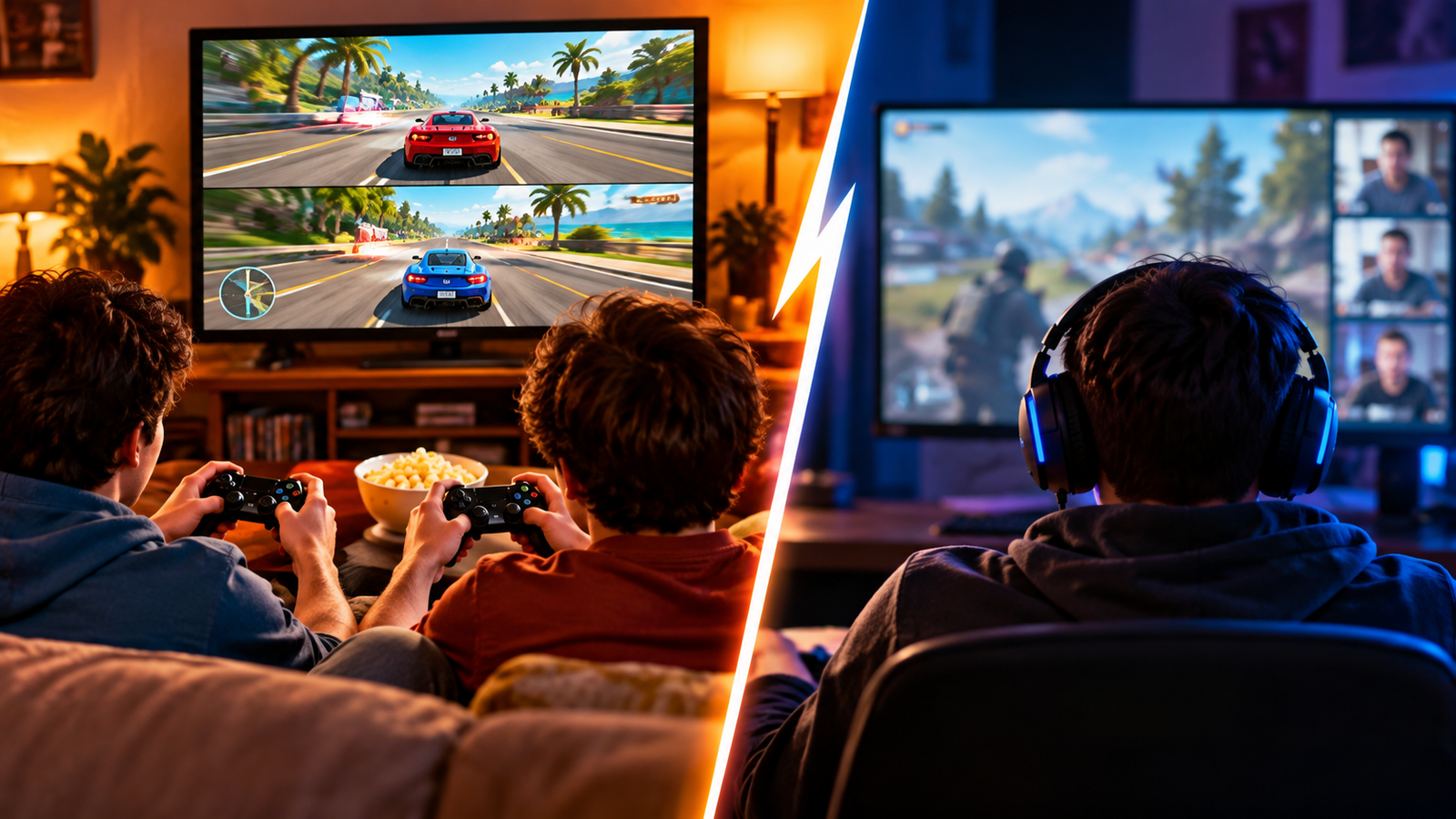
Video games have changed a lot over the years. Games now have huge maps, better graphics, faster online play, and worlds that can feel almost real. Players can meet friends from different parts of the world without ever sitting in the same room.
Yet, one old game feature still has a special place in the hearts of many players: local split-screen multiplayer.
The idea was simple. Two or more people sat in the same room and played the same game on one screen. The screen split into sections, with each player able to see their own part of the game. There was no need for a second console, a separate room, or a stable internet connection.
Today, this feature is far less common than it once was. That is a shame because local split-screen multiplayer offered something that online play cannot fully replace.
A Simple Way to Play Together
One of the best things about split-screen play was its simplicity.
A friend could come over, pick up a controller, and join the game. There was no need to create an account, wait for a download, deal with a connection problem, or search for an online lobby.
The experience could start within minutes.
This made local multiplayer feel natural. It was not treated as a separate event. It was simply part of the game.
A racing game could turn into a small competition between friends. A sports game could lead to a close match. A shooter could create moments of joy, surprise, and even a little frustration.
The important part was that everyone was there together.
The Screen Was Part of the Fun
Split-screen had another feature that made it special: everyone could see the same screen.
Of course, this could create problems. Players could sometimes look at another person’s section of the screen. In some games, this was almost part of the fun.
Friends could tease each other, call out what they saw, or try to hide their plans. A simple match could become much more personal because the people involved were sitting only a few feet apart.
That sense of closeness is hard to copy online.
Online multiplayer gives players a way to speak through a headset or chat. Local multiplayer gives them facial expressions, laughter, reactions, and real conversations. A funny moment does not need a voice chat message. Everyone in the room sees it at once.
It Made Games More Social
Video games have often been called a solo hobby, but local multiplayer showed that games could bring people together.
A console in a living room could become the center of a small social event. Friends could sit around the television and take turns. Families could play sports games. Siblings could compete against each other. Even people who did not play games often could pick up a controller and join.
This made games feel less isolated.
The best part was that the game did not always need to be the main focus. People could talk while they played. They could joke about mistakes, celebrate a good move, or argue about who had the better score.
The game became a shared activity rather than something one person did alone.
Online Multiplayer Changed Everything
The rise of online multiplayer changed the way people play games.
There are clear benefits. Players can meet others from almost anywhere. Friends do not need to live in the same city. A group can play together even when everyone is at home.
This made online multiplayer a natural choice for many developers.
At the same time, local multiplayer became harder to justify for some games. A developer could create an online mode that allowed players to connect across the world. Local split-screen could require extra work to make sure the game ran well on one system with several players on the same screen.
As games became larger and more complex, split-screen also became less common.
But the decline of the feature does not mean players stopped enjoying it.
Modern Games Could Bring It Back
Modern consoles and gaming hardware are powerful enough to support large and detailed game worlds. That creates an interesting opportunity.
Developers could use modern technology to give local multiplayer a fresh look.
A game does not need to copy the exact split-screen style of older titles. It could offer flexible screen layouts, simple controls, and easy local play. Players could sit together and join a match without a long setup process.
This could work especially well for racing games, sports titles, party games, action games, and cooperative adventures.
A modern local multiplayer mode could also work alongside online play. A group of friends in one room could play with another group somewhere else.
That would combine the best parts of both ideas.
Why It Still Matters
The biggest reason for a comeback is not technology. It is the experience.
Local multiplayer creates a different kind of memory.
People remember the game they played, but they also remember who sat beside them. They remember the loud reaction after a last-second win. They remember the joke that had nothing to do with the game. They remember the friend who always picked the same character or the person who refused to admit defeat.
These small moments give games a life beyond the screen.
An online match can be exciting, but it can also end as soon as the connection closes. A local match can become part of a real social memory.
That difference matters.
The Value of Shared Play
There is also something refreshing about a game that asks people to share the same physical space.
Modern life can keep people apart even when they are connected through technology. Friends may talk through messages all day but still rarely sit together.
A local multiplayer game gives them a reason to do that.
It does not need a huge story or a massive online world. It only needs a few controllers, a screen, and a good game.
That simple setup can be enough for hours of fun.
A Feature Worth Another Chance
Local split-screen multiplayer does not need to replace online gaming. It does not even need to appear in every game.
It simply deserves more chances.
Developers have shown how far games can go with online worlds, live services, massive maps, and complex systems. There is no reason to leave simple local play behind just because newer technology exists.
Sometimes, an old idea remains useful because it solves a basic problem in the best possible way.
Local split-screen lets people play together in the same room. That is all it promises, but that is also its strength.
The Comeback Could Be Simple
A comeback does not need to be a major industry trend. A few well-made games could show players that local multiplayer still has value.
The goal should not be to copy the past exactly. Developers can take the old idea and build it around modern games.
Easy setup, smooth performance, clear controls, and support for both local and online players could make the feature feel fresh again.
More importantly, games could once again give people a reason to hand a controller to the person sitting beside them.
Some Features Should Not Disappear
The game industry often moves toward whatever is bigger, newer, and easier to sell. That progress can bring great ideas, but it can also push older features aside.
Local split-screen multiplayer is one feature that deserves another look.
It was simple. It was social. It was easy to understand. Most of all, it made games feel like something people could enjoy together in the same physical space.
Online multiplayer gave players a bigger world.
Local multiplayer gave them a shared room.
Both have value, but the second one deserves a much bigger comeback.
ALSO READ: The Fantasy Playoff Edge You Can Build Months Early