









When people talk about strength, they often focus on one big number. They may talk about how much they can bench press, squat, or deadlift. A bigger number can feel like proof of great strength.
But real strength is not only about how much weight you can lift.
Your body works as one system. Your legs, hips, back, core, shoulders, and arms all have to work together. If one part is much weaker than the others, it can affect the whole movement.
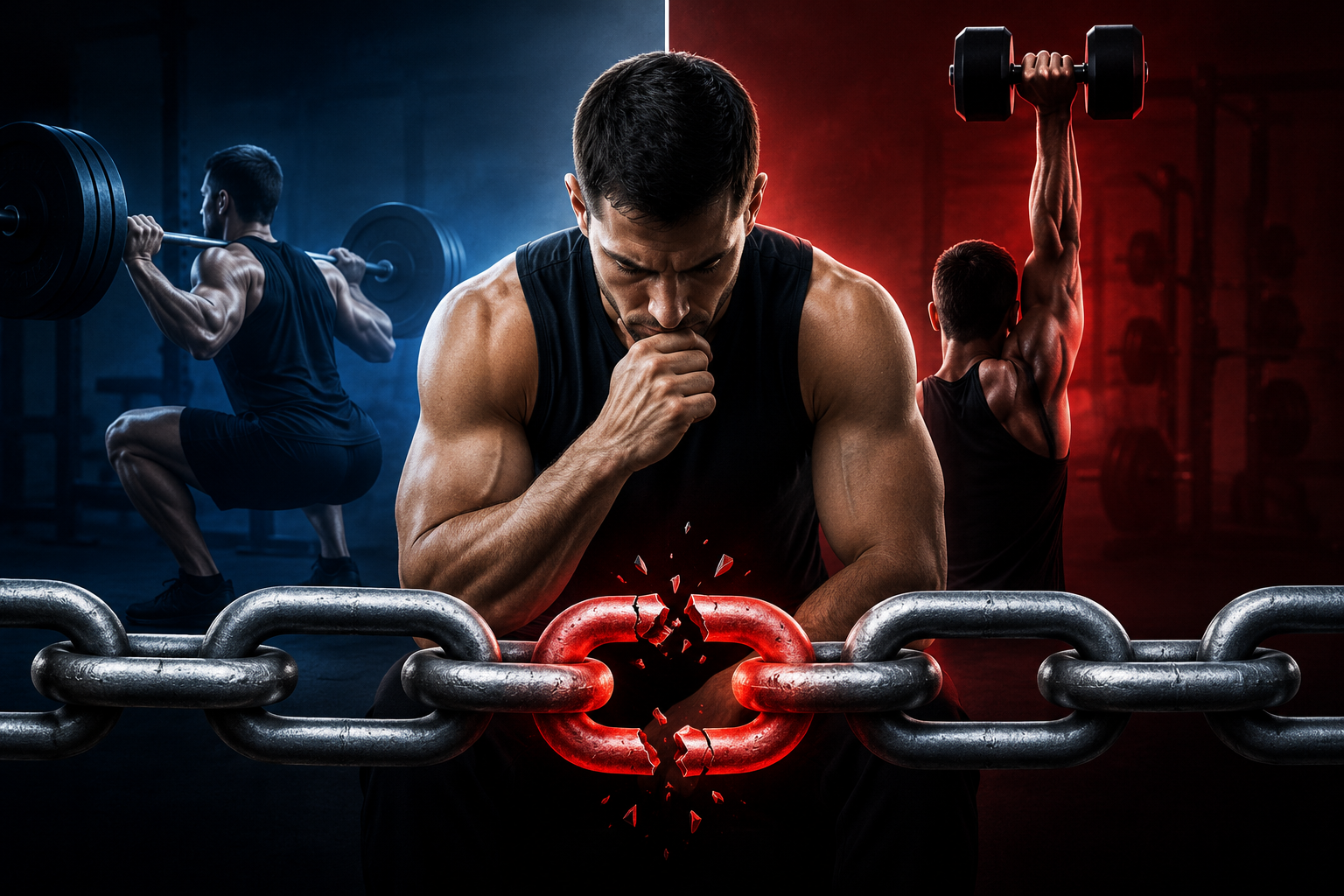
This weak area is your weak link.
You may have strong legs but poor core control. You may have a powerful upper body but weak shoulders. You may be able to lift a heavy weight with both hands but struggle when you use one side at a time.
That is why a simple strength test can tell you more than a single maximum lift.
What Is a Weak Link?
A weak link is the part of your body that limits your performance.
Think about a chain. A chain can have many strong links, but one weak link can still cause the whole chain to fail. Your body works in a similar way.
You might have strong muscles, but if your balance, grip, core control, or joint stability is poor, that weakness can limit what you can do.
The weak link does not always feel like a weak muscle.
Sometimes, it shows up as poor balance. Sometimes, one side of your body does more work than the other. You may also notice that your form breaks down at a certain point.
These small signs can reveal a bigger problem.
The Simple Test
One useful way to find your weak link is to compare your strength on each side of your body.
A simple single-leg or single-arm exercise can help. The idea is to make each side work on its own instead of letting your stronger side help your weaker side.
For the lower body, a single-leg squat variation can work well. You can also use a split squat. For the upper body, a single-arm press or row can give you useful information.
The key is not to chase a huge weight.
Choose a load that lets you use good form. Perform the same number of controlled reps on both sides. Pay close attention to how each side feels and moves.
If one side feels much harder, loses control sooner, or cannot match the other side, you may have found your weak link.
Do Not Test Your Limit First
A common mistake is to start with the heaviest weight possible.
That does not always give you useful information. Heavy weight can hide movement problems because your body may find ways to complete the task.
A lighter load with slow, controlled movement can tell you much more.
For example, you may notice that your left leg shakes during a single-leg movement while your right leg stays stable. You may also find that one shoulder moves differently from the other.
These details matter.
The goal of the test is not to prove how strong you are. The goal is to learn where your body needs more attention.
Look at More Than Reps
The number of reps is only one part of the test.
Pay attention to your control. Can you keep your knee in a good position? Can you keep your hips level? Can you maintain a steady torso? Can you move through the same range on both sides?
Also notice your breathing and effort.
If one side feels far harder even with the same weight and number of reps, that difference can be useful.
Your body often gives you clues before a real problem appears.
A loss of balance, a change in posture, or a sudden drop in control can show that a certain area cannot handle the same demand as the rest of your body.
Why Side-to-Side Strength Matters
Most people have a stronger side.
This is normal. Daily life can create small differences between the left and right sides of the body. You may use one hand more often, place more weight on one leg, or favor one side during sport.
Small differences are not always a problem.
Large differences can matter more.
When one side does most of the work, the stronger side may take over during exercise. This can make the weaker side stay weak because it does not get the same amount of work.
A single-side test removes some of that help.
It gives each side its own job.
Your Core May Be the Real Weak Link
Many people assume that a weak link must be a small muscle.
That is not always true.
Your core can be the missing piece. Your core helps connect your upper and lower body. It also helps you control your body when you lift, push, pull, run, jump, or change direction.
If your core cannot keep your body stable, strong muscles may not work at their full level.
You might have strong legs but poor control during a single-leg movement. You might have strong shoulders but struggle to keep your body stable during a single-arm press.
In such cases, the problem may not be the main muscle you are testing. Your core may be the part that needs more work.
What Your Form Can Tell You
Your form can act like a report card.
If your knee moves inward during a single-leg exercise, you may lack control around the hip and leg. If your lower back takes over during a core exercise, your trunk may need more strength and control.
If your shoulder moves in a strange way during a press, your shoulder or upper back may need attention.
These signs do not automatically mean you have an injury.
They simply show that a movement is harder for you in a certain area.
That information can help you choose better exercises.
What To Do After You Find It
Finding your weak link is only the first step.
Once you know where the gap is, give that area more focused work. Use simple exercises first. Keep the weight under control and focus on good movement.
Do not try to fix the problem with endless heavy sets.
Quality matters more than ego.
If one side is weaker, you can start with that side. Match the same number of reps on the stronger side rather than doing extra work with it.
Over time, the goal is to reduce the difference.
You do not need perfect balance. You need enough strength and control to let your whole body work well together.
Retest After Some Time
A strength test becomes more useful when you repeat it.
After several weeks of focused training, use the same exercise, the same setup, and a similar load. Compare the results with your first test.
Look for better control, smoother movement, and less difference between the two sides.
The number on the weight may improve too, but that is not the only sign of progress.
A movement that once felt unstable may now feel solid. A side that once tired early may now match the other side.
Those changes show that your body has become more capable.
Strength Means More Than Heavy Weights
True strength is not just about lifting the biggest weight in the gym.
It is about control, balance, stability, and the ability to use your strength when your body has to work as one unit.
The strongest person is not always the person with the biggest lift.
Sometimes, the better measure is how well the body handles a simple movement on its own.
That is why a basic strength test can be so useful. It can reveal the part that holds you back, even when your overall strength looks good.
Find that weak link, train it with patience, and give your body a chance to become stronger as a whole.
ALSO READ: What Went Wrong With Dream11? The Full Story in 2026