







Can artificial intelligence really tell us that an injury will happen before it happens? The short answer is yes, but only to a certain point.
AI cannot look at an athlete and say, “You will tear your ACL next Tuesday.” It does not have that level of certainty. What it can do is study large amounts of data and find patterns that may show a higher chance of injury.
This makes AI useful as a warning system. It can help athletes, coaches, and medical teams notice signs that may point to a higher injury risk. The main idea is not to predict the exact injury or the exact date. The goal is to spot a risky condition early and give people a chance to act.
How Does AI Find Injury Risk?
AI works by studying data. It can look at many details about an athlete and compare them with patterns from other people.
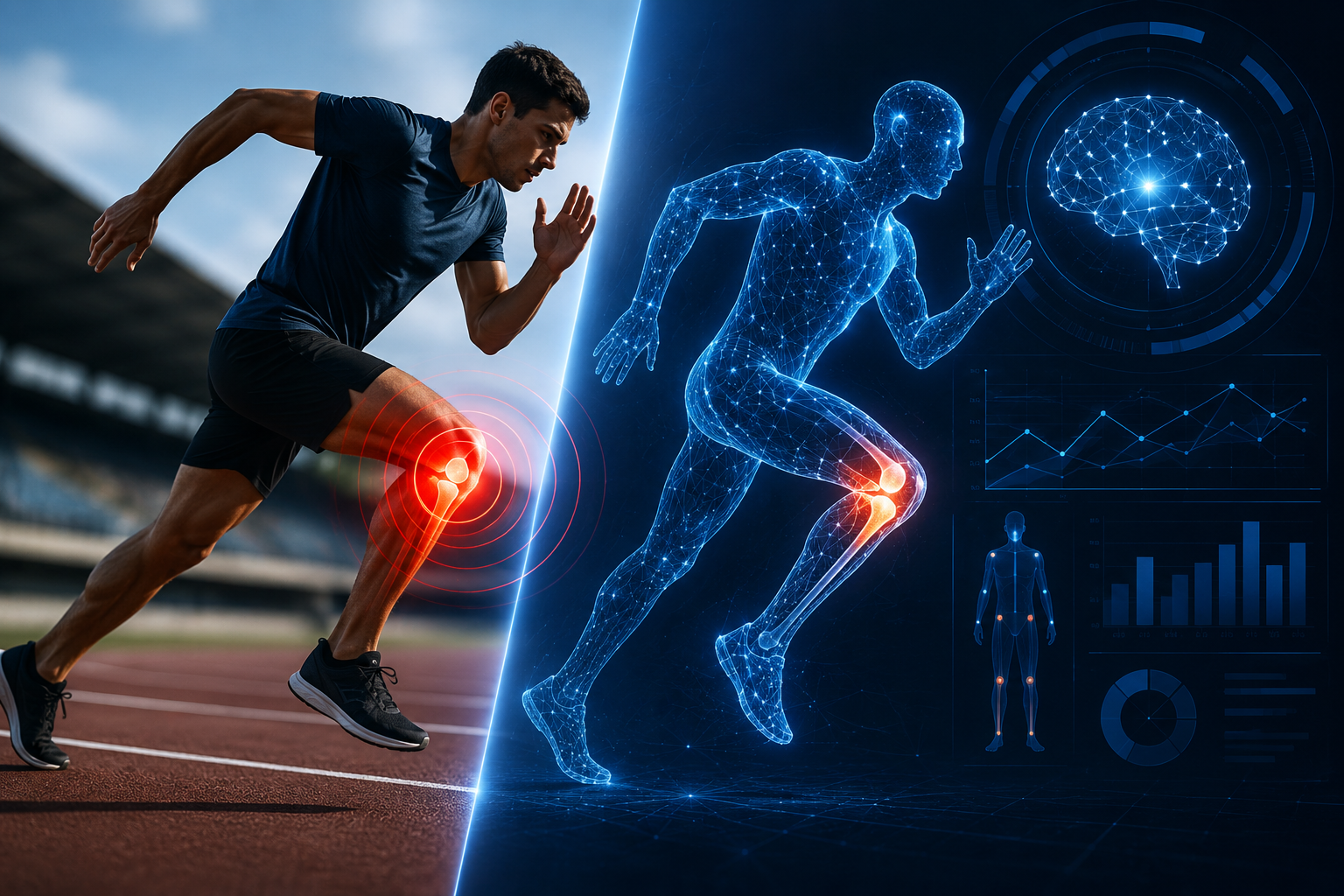
One area is movement. Cameras and sensors can record how a person walks, runs, jumps, or changes direction. AI can study joint angles, balance, body position, and other parts of movement. It may find small changes that are hard for a person to notice.
Training load is another useful source of data. If an athlete suddenly runs much farther, trains harder, or adds more intense sessions, the body may face extra stress. AI can compare recent workloads with past activity and look for unusual changes.
Wearable devices can also provide useful information. Heart rate, sleep, recovery, GPS data, and acceleration can help create a picture of how the body responds to exercise.
Past injuries matter too. An athlete who had an injury before may have a different risk profile. AI can study the location, severity, and recovery history of past injuries and compare that information with current data.
Performance can also provide clues. A drop in speed, changes in movement, or more body asymmetry may show that an athlete is tired or not moving as usual.
Video adds another layer. AI can study sports footage and look for small changes in technique or movement. These changes may not prove that an injury will happen, but they can add useful information to a risk estimate.
A Simple Example
Imagine a football player who has had a knee injury in the past.
Over several weeks, the player starts to train more often. The total workload rises sharply. At the same time, wearable data shows signs of fatigue. Video also shows that the player now puts more force on one leg than the other.
A human coach may notice some of these changes. An AI system can combine all of them and compare the pattern with data from other athletes.
The system may then say that the player’s injury risk is higher than normal.
That does not mean an injury will definitely happen. It means the current pattern looks similar to patterns that have appeared before injuries.
The coach may then choose to reduce the player’s workload, allow more recovery, or ask a medical professional to assess the athlete.
Risk Is Not the Same as Prediction
This is one of the most important points about AI and injuries.
There is a major difference between injury risk and injury prediction.
Risk means there may be a greater chance of an injury. Prediction sounds much more certain. It suggests that the system knows what will happen.
AI is much better suited to the first task.
For example, an AI model may identify an athlete as having a higher-than-usual risk of injury. It cannot promise that the athlete will get hurt.
Many things can affect an injury. Fatigue, training, movement, the environment, genetics, past injuries, and simple chance can all play a part.
A person may have several warning signs and never get hurt. Another person may appear to have a low risk and still suffer an injury.
That is why AI should not be treated as a crystal ball.
Why Exact Predictions Are So Hard
The human body is extremely complex. Two athletes can follow the same training plan and react in very different ways.
One athlete may feel fine after a hard session. Another may need several days to recover. A small change in movement may also have a different meaning for different people.
There is another problem: injuries are not always caused by one factor.
A player may have a high training load, poor sleep, and muscle fatigue. None of these factors alone may cause an injury. But together, they could raise the risk.
AI can study these factors together, which is one of its strengths. Still, it cannot control every part of real life.
A sudden change in the playing surface, an awkward landing, contact with another player, or an unexpected movement can lead to an injury with little warning.
Where AI Can Help Most
The most useful role for AI may be early warning.
Think of injury risk as a scale. An athlete may first show a normal pattern. Later, fatigue may rise. Movement may change. Training load may become too high. The AI system may then notice that the overall pattern has moved into a higher-risk state.
This can give the athlete or coach time to make a change.
They might lower the training load, add more recovery, review technique, or ask a medical professional for advice.
The value of AI is therefore not perfect prediction. Its value is the chance to spot a problem before it becomes a serious one.
AI Still Needs Good Data
An AI system is only as useful as the data it receives.
If the data is poor, incomplete, or wrong, the result may also be poor.
For example, a wearable device may miss part of an athlete’s activity. A camera may not capture a movement from the right angle. Training records may also leave out important details.
There is another concern. A model may work well with one group of athletes but perform less well with another group.
A system trained mostly on professional athletes may not give the same results for young athletes, older adults, or people who take part in different sports.
This is why AI models need careful testing before people trust their results.
AI Should Support People, Not Replace Them
AI can provide useful information, but it should not replace coaches, doctors, physiotherapists, or the athlete’s own judgment.
A risk score is only one part of the picture.
A medical professional can ask questions, examine the athlete, understand their history, and consider details that a computer may not see.
The best approach is likely to combine both sides. AI can process huge amounts of data and find patterns. Human experts can use that information along with their knowledge and direct assessment.
This creates a stronger system than either side could provide alone.
What the Future May Look Like
As wearable devices, cameras, and sports technology improve, AI may become better at spotting unusual patterns.
Future systems could give athletes more personal feedback based on their own normal movement and recovery. Instead of only comparing one person with a large group, AI could learn what is normal for that specific athlete.
That could make warning signs more useful.
However, better technology will not remove uncertainty. No system can fully control the many factors that affect an injury.
The aim should remain clear: find useful warning signs early, reduce avoidable risk, and help people make better choices.
The Real Answer
So, can AI really predict an injury before it happens?
Not with certainty.
AI cannot reliably tell an individual athlete exactly when an injury will happen or guarantee that one will occur. What it can do is study movement, training load, wearable data, past injuries, performance changes, fatigue, and video to estimate whether injury risk appears higher than normal.
That difference matters.
AI is not a fortune teller. It is better viewed as an early warning tool.
If an AI system notices a pattern that looks risky, people can take action before a problem becomes worse. That may mean less training, more recovery, a change in technique, or a professional medical check.
The real promise of AI is therefore not perfect prediction. It is earlier awareness.
And in sports, even a small amount of extra warning can sometimes make a very big difference.