








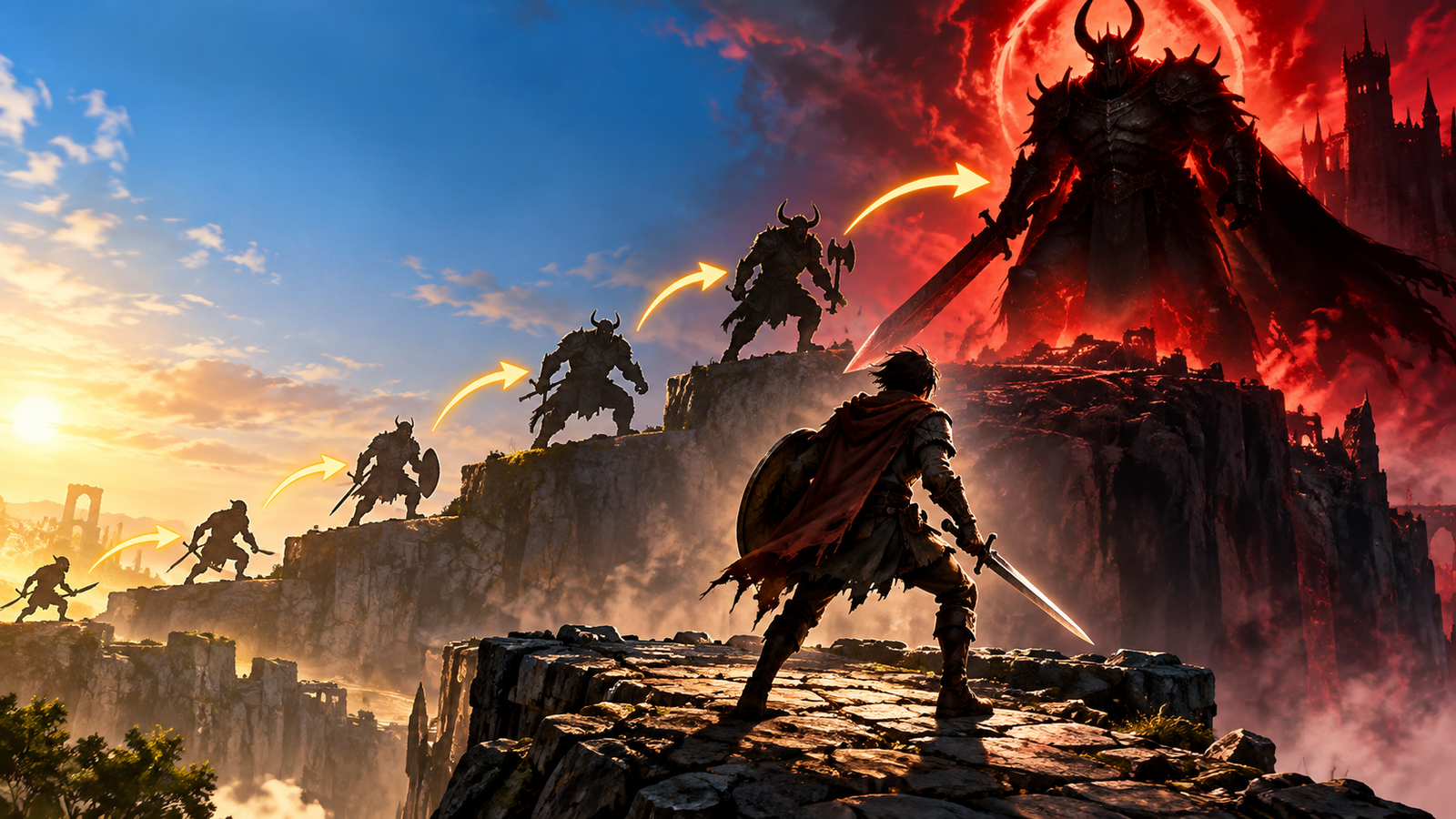
A difficulty spike is a clear rise in challenge during a game. It can come through a stronger enemy, a harder level, a complex puzzle, or a boss fight. The goal is not only to make the game harder. A good spike should make the player use what they have learned and test their skills in a new way.
The best difficulty spikes create a special feeling. The player may struggle, fail, and feel close to defeat. Yet they still believe that success is possible. That feeling keeps them focused on the game. They want to understand the challenge, improve their skills, and try again.
A bad difficulty spike creates a very different response. The player may feel that the game has cheated them. They may not understand why they lost or what they should do next. When this happens, the challenge stops feel rewarding and starts feel unfair.
The psychology behind a perfect difficulty spike comes from this simple idea: the challenge must feel hard, but the player must still feel capable.
The Balance Between Skill and Challenge
The idea of balance is closely linked to flow theory, which comes from psychologist Mihaly Csikszentmihalyi. Flow is a state where a person has deep focus on a task and loses much of their sense of time.
Games can create this state when the player’s skill is close to the level of the challenge. If a game is too easy, the player may become bored. If it is far too hard, the player may feel stress or frustration. But when the challenge sits just above the player’s current skill, the game can feel exciting.
This is why a good difficulty spike should not feel like a huge jump. It should feel like a step forward.
The player should think, “This is harder than before, but I know I can learn it.” That small sense of hope is very important. It keeps the player in control and gives the challenge a clear purpose.
Why Struggle Makes Victory Feel Better
A victory has more emotional value when the player has to work for it. If an enemy falls after one simple attack, the player may not feel much. There was no real test of skill.
A hard fight creates a stronger emotional path. The player may lose several times. Each loss gives them a chance to notice a mistake. They may then change their plan, react faster, or learn the enemy’s attack pattern.
When they finally win, the victory feels personal. They know that their own effort made the difference.
This is one reason hard games can create strong memories. The player does not just remember the reward. They remember the struggle before the reward.
The pattern is simple: struggle leads to learning, learning leads to better skill, and better skill leads to mastery. The final victory then feels earned.
The Power of “I Can Do This”
A player needs to believe that their actions can lead to success. This idea relates to self-efficacy, or the belief that a person can handle a task through their own ability and effort.
A well-made difficulty spike tells the player, “You do not know how to beat this yet.”
A poor one tells them, “You cannot beat this.”
These two messages may look similar, but they create very different emotions.
A fair boss may have clear attack patterns. Its moves may seem difficult at first, but the player can slowly understand them. The player sees a path toward victory.
The game should give enough evidence that success is possible. The enemy may have clear weak points. The player may have useful tools. The attacks may have clear visual or sound cues. Failure may reveal what went wrong.
When these parts work together, the player sees failure as useful information rather than pure punishment.
Why Clear Signals Matter
Players need information when they face a new threat. This is why game designers use telegraphing. An enemy may raise its weapon before an attack. A sound may play before a dangerous move. A boss may change its stance before a powerful strike.
These signals give the brain time to react.
The player starts to build a simple chain: see the cue, predict the attack, then respond.
At first, this process takes effort. After many attempts, it becomes more natural. The player no longer needs to think about every small detail. They have learned the enemy’s language.
This makes a great difficulty spike feel fair. The player may still lose, but after each attempt, they can understand a little more.
The best response after failure is often, “Oh, now I understand.”
That moment shows that the game has taught the player something.
Use What the Player Has Learned
A strong difficulty spike should usually test skills that the game has already taught.
Suppose an early level teaches the player how to dodge. A later level may ask them to dodge several attacks at once. A boss fight may then combine dodge timing with enemy movement and careful positioning.
The game has not suddenly changed its rules. It has simply asked the player to use those rules at a higher level.
This makes the challenge feel earned.
It is similar to a school exam. A good exam asks students to use ideas they have already learned. It does not suddenly test a completely different subject.
The same idea works in games. The player should feel that the difficulty spike is the result of their progress.
Failure Should Not Waste Too Much Time
The cost of failure also affects how players react to difficulty.
Imagine a player loses a boss fight and must wait through a long loading screen. Then they must replay ten minutes of easy content before they can face the boss again.
The player may stop focus on the lesson and start focus on the wasted time.
A fast retry system creates a better loop. The player fails, learns something, and gets another chance soon after.
This turns failure into part of the game itself.
Games such as Celeste, Hades, and Super Meat Boy show how fast retries can support hard challenges. The player can make many attempts without a huge time cost.
This matters because improvement often needs repetition. If the game makes each attempt easy to repeat, players have more chances to learn.
Why Near Victories Feel So Powerful
A near victory can create a very strong desire to try again.
If a player dies at the start of a boss fight, they may feel far from success. But if they reduce the boss to five percent health before they lose, the reaction can be very different.
They may think, “I almost had it.”
That thought creates hope. The player has proof that victory is within reach.
This relates to the goal-gradient effect. As people feel closer to a goal, their motivation can rise.
Games use this idea through boss health bars, phase changes, checkpoints, and visible progress. These features show the player that their effort has produced results.
A near win can turn frustration into motivation.
A Spike Needs the Right Preparation
A sudden increase in challenge does not always make a good difficulty spike.
Preparation matters. If a game spends hours teaching careful movement and then creates a new enemy with an instant attack that gives no warning, the player may have no useful way to respond.
That is not a meaningful test of skill. It may simply feel like a surprise.
A good spike asks, “Can you use what you know under pressure?”
A poor spike asks, “Could you have guessed this strange new rule?”
That difference is at the heart of fair game design.
From Practice to Mastery
The strongest difficulty curves often follow a clear path. First, the game introduces a mechanic. Then the player gets time to practice it. After that, the game adds a small change. Later, it adds pressure. Finally, the player faces a major test.
For example, an early enemy may have one slow attack. The player learns how to avoid it. Later, a faster enemy uses a similar attack. At the end, a boss may combine both ideas with new movement and timing demands.
The final fight feels hard because several known skills must work together.
That is what makes the challenge satisfying. The player can look back and see how the game prepared them for the moment.
The Importance of Emotional Rhythm
A game should not make every moment hard.
Players need moments of comfort between major challenges. After a difficult fight, a quieter section can give them time to recover. They may explore an area, enjoy the story, or use their new skills without heavy pressure.
Then the game can slowly raise the challenge again.
This creates an emotional rhythm: comfort, challenge, struggle, mastery, relief, and then a new challenge.
Without this rhythm, constant pressure can lose its effect. If everything feels like a difficulty spike, no moment feels special.
A perfect spike stands out because the game gives the player enough space before and after it.
What Makes a Difficulty Spike Perfect?
A perfect difficulty spike is not simply a moment with more enemies or higher damage. It is a carefully placed test of player skill.
The challenge should feel high, but the rules should remain clear. The player should have the tools they need. Failure should provide useful feedback. Retries should not waste too much time. Progress should be easy to notice.
Most importantly, the player should believe that the next attempt could succeed.
That belief is what creates the famous “one more try” feeling.
The best difficulty spikes do more than make games harder. They create a path from failure to understanding, and from understanding to mastery. When the player finally wins, they do not just feel that the game has rewarded them.
They feel that they have become better.