









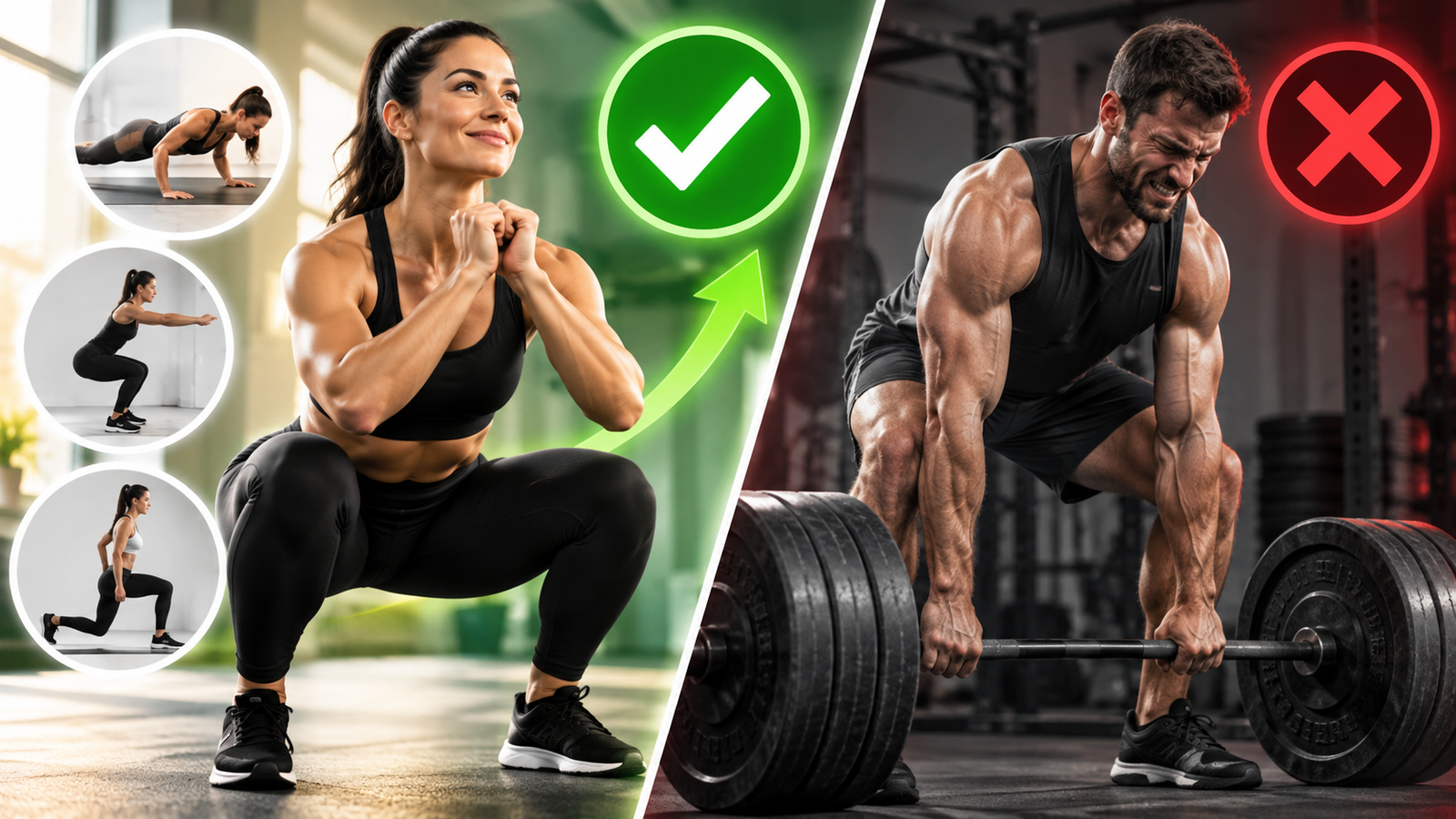
Many people think strength only comes from one thing: lifting more weight. If you can squat 80 kg today and 90 kg next month, it may seem clear that you have become stronger. While more weight can show progress, it is not the only way to gain strength.
You can become much stronger while you use the same weight for weeks or even months. The key is to make your muscles work harder and to improve how well you perform an exercise.
Your body does not only respond to the number on a dumbbell or barbell. It also responds to how many reps you do, how well you control each rep, how far you move the weight, and how difficult the exercise feels.
This means you do not need to chase heavier weights at every workout. Instead, you can focus on better performance.
More Reps Can Show Progress
One simple way to get stronger without more weight is to do more reps with the same load.
For example, suppose you use 60 kg for the bench press. At first, you may manage only 7 reps. After a few weeks, you may do 8, then 9, and later 10 reps with the same weight.
That is real progress.
Your muscles can now handle more work than before. Your body has adapted to the exercise, and your ability has improved.
A useful method is called double progression. You choose a weight and a rep range, such as 3 sets of 6 to 10 reps. You keep the same weight and slowly work toward the top of that range.
For a bench press at 60 kg, your progress could look like this: 7, 7, 6 reps at first, then 8, 8, 7 reps, followed by 9, 8, 8 reps. Once you reach 10, 10, 10 with good form, you can move to 62.5 kg and start again near 6 to 8 reps.
This approach lets you improve without the need to add weight every session.
Tempo Can Make the Same Weight Harder
The speed of each rep also matters. A slow and controlled rep can make a normal weight feel much harder.
Take a squat as an example. You may normally lower your body in one second and then stand up. Instead, you can take three to five seconds on the way down.
The weight has not changed, but the exercise has become more difficult.
A slow lowering phase can help you control the movement and place more demand on the muscles. You can also add a short pause at the hardest part of an exercise.
For example, you can pause at the bottom of a squat before you stand up. In a bench press, you can pause the bar near your chest before you press it upward.
These small changes can create a new challenge without a heavier bar.
Better Form Can Make You Stronger
Your technique can also affect your strength.
Poor form can make an exercise less effective and may make it harder to use your strength well. Better technique can help you use your muscles in a more efficient way.
Suppose your squat form improves over time. Your body position becomes more stable, your movement becomes more controlled, and you use a better range. You may then perform more reps with the same weight.
That is a sign of progress.
Good form also gives you a better base for future strength gains. You do not need to rush to a heavier weight if your current weight still offers room for better technique.
A Bigger Range Can Increase the Challenge
Another way to make an exercise harder is to use a larger range of motion.
A squat that goes deeper can be harder than a shallow squat. A press with a full range can require more work than a short movement.
This does not mean that everyone must use the deepest possible range in every exercise. Your body, mobility, exercise choice, and goals all matter.
The main idea is simple: if you can use a safe and useful range of motion, a larger range can make the same load more demanding.
You may not add a single kilogram, yet the exercise can still become harder.
More Sets Can Add More Work
You can also add a set instead of adding weight.
Imagine that you do three sets of an exercise with 60 kg. After some time, you may feel ready for four sets with the same weight.
The load stays the same, but your total work rises.
This can help you improve your ability to handle a certain exercise. It can also support muscle growth, which matters because larger and stronger muscles can help with force production.
However, more sets are not always better. You still need enough rest and recovery. Your body needs time to repair itself and adapt to the stress of training.
Harder Exercise Versions Can Help
Sometimes the best way to get stronger is not to add weight but to choose a harder version of an exercise.
A regular push-up may become a feet-elevated push-up. Later, you may use a weighted push-up.
The same idea works with many other exercises. A normal squat can become a split squat. A two-leg movement can become a single-leg version. A regular row can become a one-arm row.
Unilateral exercises can make a moderate load feel much harder because one side of the body must do more of the work.
This can be useful when you have limited equipment or when you simply want a new challenge.
Strength and Muscle Growth Are Not Exactly the Same
There is an important difference between general strength and maximum strength.
If your goal is to increase your one-rep maximum on a squat, bench press, or deadlift, some work with heavier loads can be useful. Your muscles need to produce high force, but your nervous system and technique also need practice with heavy loads.
That does not mean you need to test your maximum every week.
You can spend most of your training with moderate weights and still make excellent progress. At certain points, some heavier work can help you become better at maximum force.
For muscle growth and general strength, moderate weights can work very well. You can use good form, a useful range of motion, enough reps, and gradual progress without always adding more weight.
You Do Not Need to Add Weight Every Workout
One of the biggest mistakes in strength training is the belief that every workout must have a heavier weight.
That mindset can create unnecessary pressure. It can also lead to poor form when you try to lift a weight that your body is not ready to handle.
Progress can take many forms.
You may do more reps. You may use better technique. You may control the weight better. You may use a fuller range. You may add a set. You may use a harder exercise version.
All of these can show improvement.
Weight is one measure of progress, not the only measure.
Focus on Better Performance
The best approach is to focus on what you can do better today than you could before.
If you use the same 60 kg but perform more clean reps, that is progress. If you use the same dumbbell but control every rep better, that matters. If you can use a fuller range with good form, that is also an improvement.
Over time, these small gains can add up to major changes.
You can still add weight when it makes sense. In fact, heavier loads can have an important place in a well-designed strength plan. But you do not need to chase them at every workout.
Real strength comes from steady progress, good technique, enough recovery, and consistent work. The number on the weight plate is only one part of that process.