









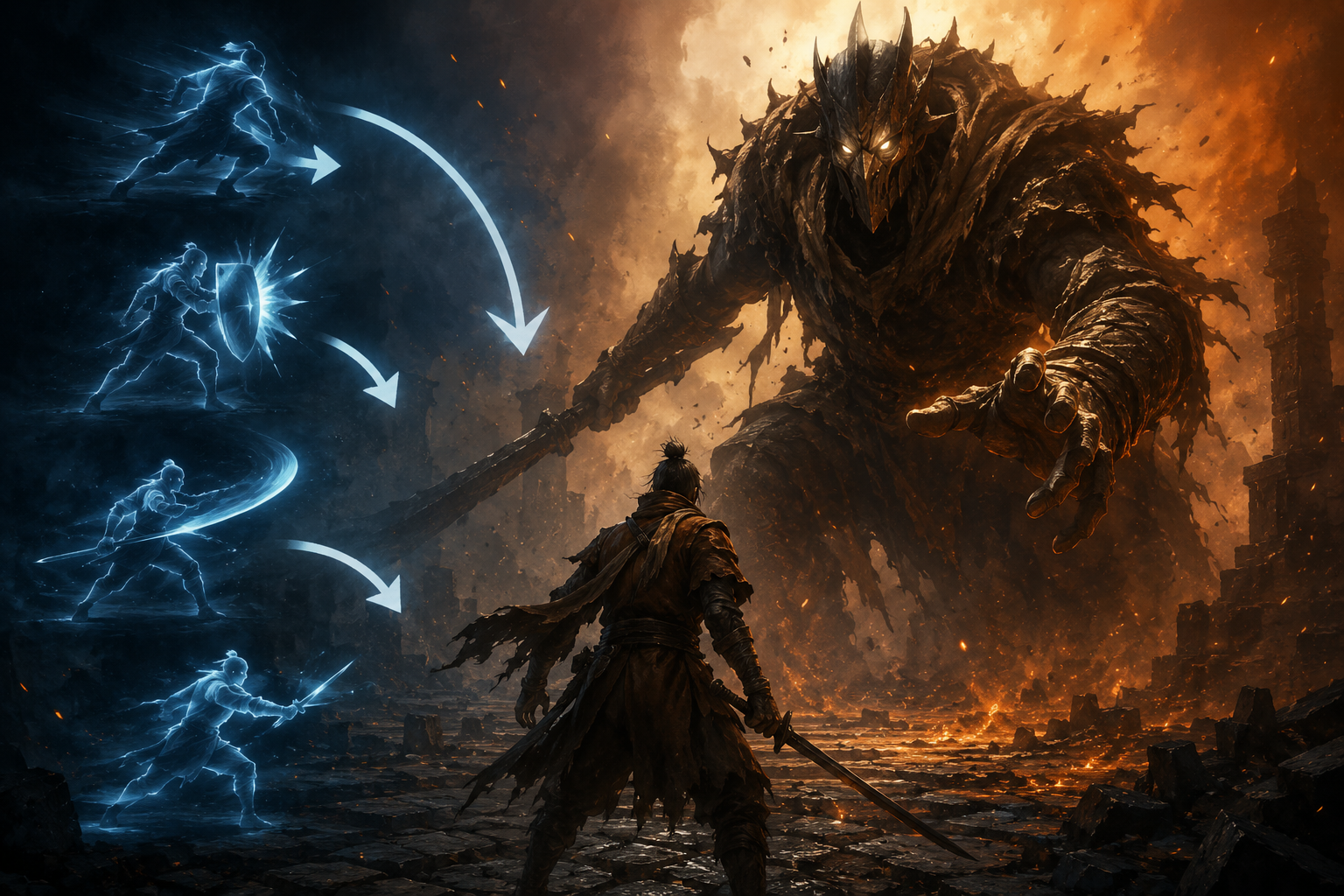
A good video game does not always need a long tutorial to teach its players. Sometimes, the best lessons come from the game itself. A boss fight can show players what to do through attacks, movement, sound, space, and timing. The player learns by trying, failing, and trying again.
This style of design can make a game feel more natural. Instead of stopping the action to explain every rule, the game gives the player a problem. The player must find the answer. When that answer works, the player feels smart because they found it on their own.
This idea is often called diegetic teaching. It means the game teaches a skill through the world and its systems instead of a separate tutorial box. Some of the best boss fights in games use this idea very well.
The Boss Becomes the Teacher
A boss fight can teach a player without saying much at all. The boss can use one clear attack to show a new idea. The player sees the attack, gets hit, and starts to understand its timing. After a few tries, the player knows when to dodge, block, jump, or move away.
The important part is that the lesson comes from play. The player does not need to read a large block of text. They learn because the boss creates a clear problem.
A well-made boss can also build the lesson step by step. First, it shows one simple move. Then it adds another move. Later, it mixes both moves together. By that point, the player has learned a useful skill without ever seeing a formal lesson.
Genichiro in Sekiro
Sekiro: Shadows Die Twice has one of the clearest examples of this idea in Genichiro Ashina. The fight asks the player to understand the main combat system of the game.
Sekiro is not a game where the player can rely only on simple attacks and repeated dodges. The player must understand deflection, posture, mikiri counters, and strong pressure. Genichiro forces the player to use these ideas in a real fight.
His attacks have clear rhythms. The player has to watch his movements and react at the right time. A successful deflection can change the flow of the fight. A mikiri counter can punish a dangerous thrust. The player slowly learns that defense is not just about survival. Good defense can also create an attack chance.
The fight can feel hard at first, but that difficulty has a purpose. It pushes the player toward the combat style that Sekiro wants. Once the player understands that style, later fights become easier to read.
Margit in Elden Ring
Elden Ring uses Margit, the Fell Omen, in a similar way. Margit teaches several useful skills without acting like a classroom lesson.
One important lesson is patience. Margit has attacks with strange delays. He may raise his weapon and wait before striking. A new player may dodge too soon. After a few mistakes, the player starts to wait for the real attack.
This teaches a very important Elden Ring skill: do not react only to what the enemy appears to do. Watch for the actual attack.
Margit also helps players understand spacing, jump timing, and attack windows. His fight asks the player to stay calm and look for small chances to deal damage.
The boss does not need to say, “Wait for the attack.” His moves explain the rule by themselves.
Father Gascoigne in Bloodborne
Bloodborne uses Father Gascoigne to teach players about speed, aggression, transformation, and the value of the environment.
Bloodborne has a fast combat style. Players who stay too far away or act too slowly can struggle. Gascoigne pushes the player toward a more active style.
The fight also has a strong phase change. Gascoigne starts as a hunter, but later becomes a beast. This tells the player that a boss may change its behavior during a fight. The player must adapt instead of relying on one plan.
The graveyard also matters. The player can use the gravestones to create space and control Gascoigne’s movement. This teaches a wider lesson: the arena itself can be part of the strategy.
The Mantis Lords in Hollow Knight
Hollow Knight has another strong example with the Mantis Lords. This fight teaches rhythm, movement, spacing, and attack patterns through direct play.
The attacks are clear enough for the player to read, but they still demand quick reactions. The fight has a strong sense of rhythm. Once the player learns where it is safe to stand and when to move, the fight becomes much more manageable.
The Mantis Lords also show how a boss can test a skill without explaining it first. The player learns the pattern through repeated attempts. Every failure gives useful information.
The result is a fight where success feels earned. The player does not simply learn a rule. They learn the boss.
Hornet in Hollow Knight
Hornet also plays an important role in how Hollow Knight teaches movement and combat. Her fights ask the player to watch movement, understand distance, react to attacks, and find short moments when an attack is safe.
This type of design works because the boss does not give the player too much information at once. The player can focus on a small set of actions. Once those actions become familiar, the game can demand more from them.
Hornet shows that a boss can act as both a challenge and a test. The fight checks whether the player has learned how to move, attack, and react under pressure.
Lady Butterfly in Sekiro
Lady Butterfly gives Sekiro another useful example. Her fight asks players to understand attack patterns, posture, and the need to react to sudden changes.
The fight also includes illusions, which create a new problem. The player cannot simply use the same plan from the start of the fight. They must understand what is real, what is dangerous, and when it is better to avoid a threat.
This creates a lesson about awareness. The player has to pay attention to the whole arena instead of watching only the boss.
Guardian Ape and Adaptation
The Guardian Ape shows another kind of lesson. A boss fight does not always need to teach one specific button or mechanic. It can teach players how to adapt.
The fight changes across its phases. The player may think they have solved the boss, only to face a new form of the same challenge. This creates a clear lesson: a successful strategy may not work forever.
That idea matters in many action games. Players need to read the situation rather than follow a fixed script.
The Pursuer and the Boss Arena
Dark Souls II uses the Pursuer to show how the arena itself can teach players. The fight has more than one possible approach, and the player can discover ways to use the space around them.
This teaches an important habit. Players should not always look only at the boss. They should also look at the room.
Walls, traps, objects, height, distance, and open space can all become part of a strategy. A good arena can therefore teach as much as the enemy itself.
The Ender Dragon and Wider Systems
Minecraft offers a different example with the Ender Dragon. It is not a traditional tutorial boss, but it can test many systems that players have learned through normal play.
Before the fight, players need useful equipment, ranged attacks, resources, and a basic sense of environmental danger. The battle brings these ideas together.
This is a powerful form of game design. Instead of teaching every system through a separate lesson, the game lets players discover those systems first. The boss later asks them to use what they already know.
Why This Design Works
Bosses can teach better than tutorials because players have a reason to care. A tutorial may tell a player that a button has a purpose. A boss gives that button a clear reason to exist.
The player also gets instant feedback. If a dodge fails, they see what happened. If a deflection works, they feel the result. If a new strategy wins the fight, the reward is clear.
This creates a simple learning cycle: try, fail, understand, improve, and win.
The Importance of Good Boss Design
Not every hard boss teaches well. Difficulty alone is not enough. A boss must give players useful information through its actions.
Its attacks should have readable signs. Its rules should stay fair. New ideas should appear at a pace the player can understand. When a boss breaks its own rules without warning, failure can feel random instead of useful.
The best boss fights make failure feel like part of the lesson. The player may lose, but they understand why. That knowledge makes the next attempt better.
Conclusion
The best boss fights do more than test a player’s skill. They build that skill.
Margit teaches patience and timing. Genichiro teaches the core combat ideas of Sekiro. Father Gascoigne teaches aggression and arena use. The Mantis Lords teach rhythm and patterns. Hornet teaches movement and spacing. Lady Butterfly teaches awareness. Guardian Ape teaches adaptation. The Pursuer teaches players to study the arena. The Ender Dragon brings many wider game systems together.
These fights show why games do not always need long tutorials. A strong enemy, a clear attack, and a fair challenge can teach a player more than a page of instructions.
When the player learns through action, the lesson becomes part of the experience. The game does not simply tell the player how to play. It gives them a reason to discover how to play. That is what can turn a difficult boss fight into one of the most memorable lessons in a game.
ALSO READ: Dae’Quan Wright Set for Historic NFL-to-College Return