







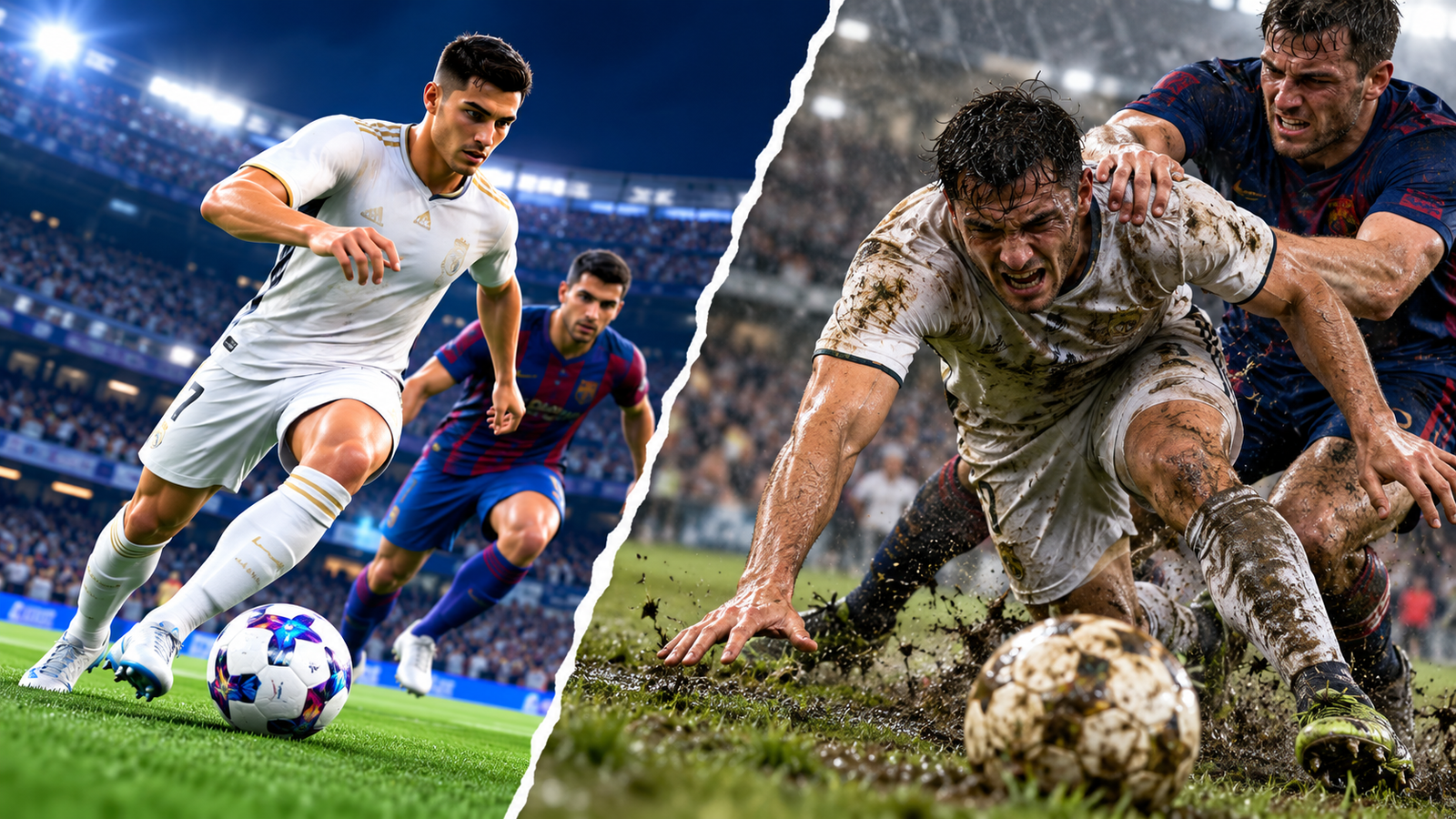
Sports games have come a long way. Modern titles can show real stadiums, famous athletes, detailed faces, realistic kits, and smooth animations. At first look, some games can seem almost like a live TV broadcast.
But visual detail is only one part of realism.
A sports game can have amazing graphics and still feel fake. The real test is simple: does the game behave like real sport? Do players move like real athletes? Do teams react to pressure? Does fatigue change how a player thinks? Do coaches adapt when a match changes?
These are the areas where sports games still have a lot of work to do.
Players Still Do Not Move Like Real Athletes
Real athletes rarely move in a perfect way. Their bodies make small changes all the time. A player may take a short step to keep balance, slow down before a turn, or lose control for a moment.
Sports games often have very good individual animations, but the change from one animation to another can look strange. A player may move from one action to the next without the small body adjustments that happen in real life.
This creates an odd problem. The animation itself may look real, but the full movement does not.
Real sport is full of small mistakes, awkward steps, poor balance, and sudden changes. Games still need to capture those details better.
Players Perform Too Well Too Often
Real athletes are not machines. Even the best player in the world can have a bad day.
A great basketball player can miss easy shots, make a poor pass, lose focus, or tire sooner than expected. A football player can make an unusual mistake after years of excellent play.
Sports games do use ratings and chance to create different results. However, players can still feel too consistent.
Real sport has a large amount of human error. That error is not simply a weakness. It is one of the reasons sport is exciting. A truly realistic game needs more natural changes in player performance from one moment to another.
Fatigue Is More Than a Stamina Bar
Most sports games use a simple stamina system. A player starts with a full bar, uses energy during the match, and becomes slower as the bar falls.
Real fatigue is much more complex.
Tiredness can affect a player’s speed, balance, reaction time, focus, technique, and choices. A tired player may see a pass but react too late. Another player may have enough energy to run but lack the focus to make the right choice.
A realistic sports game should make fatigue affect the whole player, not just their speed or stamina number.
Injuries Need More Depth
Injuries in sports games often work like simple events. A player gets hurt, an animation plays, and the game gives that player a temporary problem.
Real injuries are rarely that simple.
An athlete can play through pain. A small injury can change the way they run or move. That change can create another problem later. Recovery can also take time, and confidence can change after a serious injury.
Games do not need to copy every part of medical science, but injuries should feel less like random events and more like real physical problems.
AI Still Struggles With Space
Artificial intelligence is one of the hardest parts of sports games.
Real players constantly read space. They think about where an opponent may move next, where a teammate may run, and which area could become dangerous in a few seconds.
A defender does not only watch the ball. They also watch players, open space, team shape, and possible threats.
Game AI often follows tactical rules instead. This can create strange scenes where a defender follows the correct game rule but still makes a decision that looks completely wrong to a human player.
Better AI should understand the wider situation, not just follow a list of instructions.
Crowds Still Feel Like Background Objects
Modern stadiums can look incredible, but the crowd is often much less realistic.
Real crowds have thousands of separate reactions. People shout, celebrate, complain, leave their seats, arrive late, and react to events near them.
A goal does not create the exact same reaction from every person in the stadium.
Imagine a sports game where thousands of fans had their own simple behavior and reacted to what happened on the field. A small group near the action could react first, followed by nearby sections and then the rest of the stadium.
That would make stadiums feel far more alive.
Momentum Needs More Than Hidden Effects
Momentum is real, but it is often misunderstood in sports games.
A team does not automatically become better just because it scored or conceded. A goal can change a match because of many connected reasons. A team may become more aggressive, while the other side may become more careful. The coach may change tactics. Players may take more risks.
These changes can create what fans call momentum.
Games sometimes try to create this feeling with hidden effects or sudden changes in AI behavior. When that happens, players may feel that the game is controlling the match rather than simulating it.
A better system would let momentum come naturally from player choices, tactics, confidence, pressure, and the match situation.
Coaches Need a Bigger Role
Coaches are very important in real sport, but many games still give them a limited role.
A real coach can change a formation, move a player, alter the team’s pace, change defensive pressure, make substitutions, or target a specific opponent.
These choices can completely change a match.
In many games, coaching is still mostly a group of menus, sliders, and pre-match settings. A deeper system would allow coaches to react to events as they happen.
The coach should feel like an active part of the match rather than a menu behind it.
Referees Are More Complex Than Simple Rules
Sports games often treat referees as either perfect or random.
Real refereeing is more complicated. Officials must judge contact, position, timing, advantage, player behavior, and the wider situation.
Two similar incidents can sometimes receive different decisions because the context is different.
A realistic referee system would not only ask whether an event was technically a foul. It would also consider the position of the referee, the speed of play, the type of contact, and the situation around the incident.
Players Need More Personality
Player ratings tell us how fast, strong, or skilled an athlete is. They do not fully explain how that person behaves.
Real players have different personalities. Some ask for the ball when their team needs them. Others become less confident after a mistake. Some become more aggressive after losing a duel. Some dislike being taken off the field.
Sports games could use these traits to create more natural behavior.
Instead of giving every player a collection of numbers, games could give each athlete a deeper set of habits and reactions.
Weather Should Change More Than the Pitch
Rain in a sports game often means a wet pitch and slightly different ball physics.
Real weather can affect much more.
Rain can make movement harder. Players can lose their footing. Ball control can become less reliable. Visibility can change. Passing can become harder. Cold or heat can also affect physical effort and focus.
Weather should not simply be a visual setting. It should become part of the match itself.
The World Outside the Match Feels Too Simple
Career modes have another major problem. The match may feel detailed, but life around the match often feels like a collection of menus.
Real athletes deal with contracts, training, travel, coaches, teammates, agents, media attention, injuries, fan pressure, and personal decisions.
Games often reduce these areas to short messages, numbers, and simple choices.
A deeper career mode would make the world around the sport feel connected to what happens on the field. A poor run of form could affect confidence. A coaching change could alter a player’s role. A contract problem could create pressure.
That would make a career feel less like a spreadsheet and more like the life of an athlete.
The Next Step Is Not Just Better Graphics
Sports games already look better than ever. The next major step does not have to come from better faces, stadium textures, or sharper clothes.
The bigger change could come from better behavior.
A truly realistic sports game would combine body movement, fatigue, injuries, psychology, tactics, weather, crowds, referees, coaches, and player personalities.
The goal is not to make every player perfect.
It is almost the opposite.
Real sport is unpredictable because humans make mistakes. Players lose balance. Coaches make poor choices. Referees miss things. Crowds react in different ways. Athletes have good days and bad days.
When games can reproduce those small human details, realism will mean more than a realistic picture.
It will mean that the sport feels real.
ALSO READ: Why Physics Games Create Unplanned Magic