






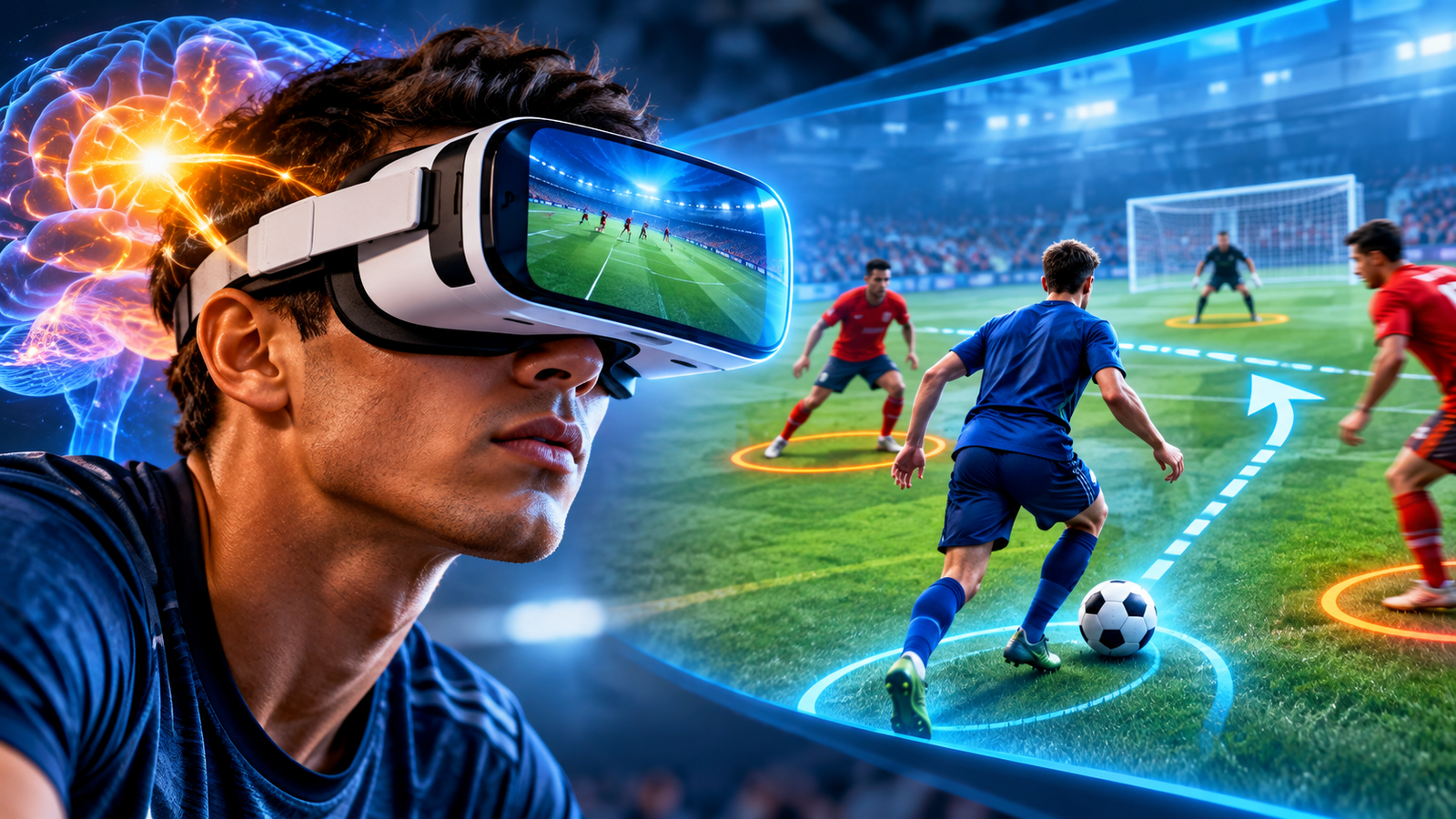
Virtual reality, or VR, is no longer just a form of entertainment. It has also found a place in sports. Coaches and athletes now use VR to study matches, practice decisions, improve visual skills, and prepare for difficult game situations. A VR headset can place an athlete inside a digital sports world where players, opponents, balls, and game events appear around them.
This raises an interesting question: Can VR actually change the way athletes see and understand a game? Research suggests that it can. VR may help athletes notice useful clues faster, understand patterns, predict what may happen next, and choose a response under time pressure. However, VR does not replace real sport practice. Its main value may come from the way it trains the brain to read a game before the body reacts.
VR Can Change What Athletes Notice
Athletes do not look at every part of a game in the same way. A skilled player may notice the position of an opponent, the movement of a teammate, or a small change in body posture within a short time. A less experienced player may miss these signs.
This skill is known as visual perception. It is very important in sports because athletes often have only a moment to understand what is happening. A 2025 systematic review examined 12 reviews and 46 research studies on VR in sports. It found that VR has been used across many sports for motor learning, visual perception, decision-making, and anticipation skills.
VR can give athletes repeated chances to look at these important details. A coach can create a situation in which a defender moves into space or an opponent prepares to make a pass. The athlete must notice the clue and react. With enough practice, the athlete may become more aware of similar signs during a real match.
It Can Help Athletes Predict What Comes Next
Good athletes often act before an event is fully clear. A tennis player may read the position of an opponent’s body before the racket hits the ball. A football player may notice a defender’s movement before a pass arrives. A basketball player may see an open lane before it becomes obvious to others.
This ability is called anticipation. It allows an athlete to make a decision before the full action takes place.
VR can create repeated situations that train this skill. The athlete can see the same type of event from different angles and at different speeds. The system can also stop a scene before the final action and ask the athlete what should happen next.
Research on perceptual-cognitive training shows that such skills can improve with practice. A 2024 review of 22 studies found positive effects on anticipation and decision-making in elite athletes. However, the improvement seen in laboratory tests was stronger than the improvement seen in real-game situations.
This difference matters. It shows that learning to predict an action inside a controlled setting does not always lead to the same level of improvement on the field.
VR Can Train Faster Decisions
Sports often give athletes very little time to choose what to do. A player may have only a few seconds, or even less, to pass, shoot, defend, or change direction.
VR allows coaches to create many decision situations without the need for a full team session. An athlete can face one situation, make a choice, and then face another. The system can also record the response and show how quickly the athlete reacted.
A recent systematic review of immersive sports training included 14 controlled studies. It found that immersive methods such as VR showed potential for better decision-making and processing speed. At the same time, the researchers noted that the studies used different methods and had limits in design and reporting.
This means the results are promising, but researchers still need stronger studies before they can make broad claims about every sport.
A Soccer Study Shows the Difference
One useful example comes from soccer. Researchers studied 26 young soccer players during an 8-week training program. Thirteen players used VR, while 13 used video on a normal screen.
Both groups improved their passing decisions and visual search skills. However, the VR group showed greater improvement in these two areas. Both groups also improved their inhibitory control, but there was no significant difference between the groups for that skill.
The result gives some support to the idea that VR can offer something beyond ordinary video. A headset can place the player inside the scene instead of showing the action from a fixed screen.
Still, one study does not prove that VR is always better. The result also came from young soccer players, so it should not automatically apply to every athlete, age group, or sport.
VR Can Make Practice More Realistic
Traditional video has value, but it often gives athletes a limited view. They watch a screen from one fixed position. VR can offer a first-person view and a wider sense of space.
This can matter in sports where the athlete must look around and react to several people at once. Research on football referees found that visual and decision behavior in VR was similar to behavior on the real field. In contrast, behavior during normal video viewing was different from what the researchers saw on the field.
This suggests that VR may create a more realistic practice setting in some cases. The athlete can feel closer to the situation and must use visual information in a more natural way.
It Can Teach Athletes Where to Look
Seeing more does not always mean seeing better. The key may be knowing where to look.
Skilled athletes often use specific visual search patterns. They may focus on areas that provide useful information rather than simply looking at the ball. Research on skilled soccer players found that more creative players used a broader visual focus, made more fixations, and looked toward more informative areas of the scene.
VR can help study and train these habits. With eye-tracking technology, researchers can record where an athlete looks during a virtual scene. Coaches may then identify whether a player watches the right area at the right time.
The 2025 VR review also noted that eye tracking can help researchers compare visual perception in VR with perception in real sport settings.
VR Has Limits
VR may change how an athlete sees a situation, but it cannot fully copy a real match. A real game has physical contact, tired muscles, noise, pressure, teammates, opponents, weather, and unexpected events.
There is also a risk that athletes become good at the VR task without gaining the same skill in real competition. This is called the transfer problem. A 2024 meta-analysis found that perceptual-cognitive training produced a larger effect in laboratory tasks than in real-game performance. The study reported an effect size of 1.51 for laboratory performance compared with 0.65 for transfer to real-game performance.
These numbers show why VR should work as a part of training rather than as a complete replacement for practice on the field.
The Future of VR in Sports
VR technology is still developing. A 2024 review of extended reality research found 57 studies on perceptual-cognitive skills in sport. Decision-making was the most common skill, studied in 60% of the research. Head-mounted displays made up 51% of the technology used, while football and handball were among the most common sports studied.
Future systems may become more realistic and more personal. A program could adjust the difficulty based on an athlete’s response. It could show faster opponents, change the viewing angle, add pressure, or create situations that match a player’s actual position.
This could make VR a useful bridge between simple video study and full physical practice.
A New Way to See the Game
VR does not simply put a game on a screen. It can place an athlete inside a situation and ask the brain to understand what matters. With repeated practice, this may help athletes recognize patterns, focus on useful information, predict actions, and make decisions faster.
The evidence so far supports its potential, especially for visual perception and decision-making. Yet the research also shows a clear limit: success inside VR does not always become success in real competition.
The best role for VR may therefore be as an extra layer of sports training. Real practice builds physical skill and teamwork, while VR can give the brain more chances to study difficult situations. Used together, these methods may help athletes not only play the game, but see the game in a new way before they act.