








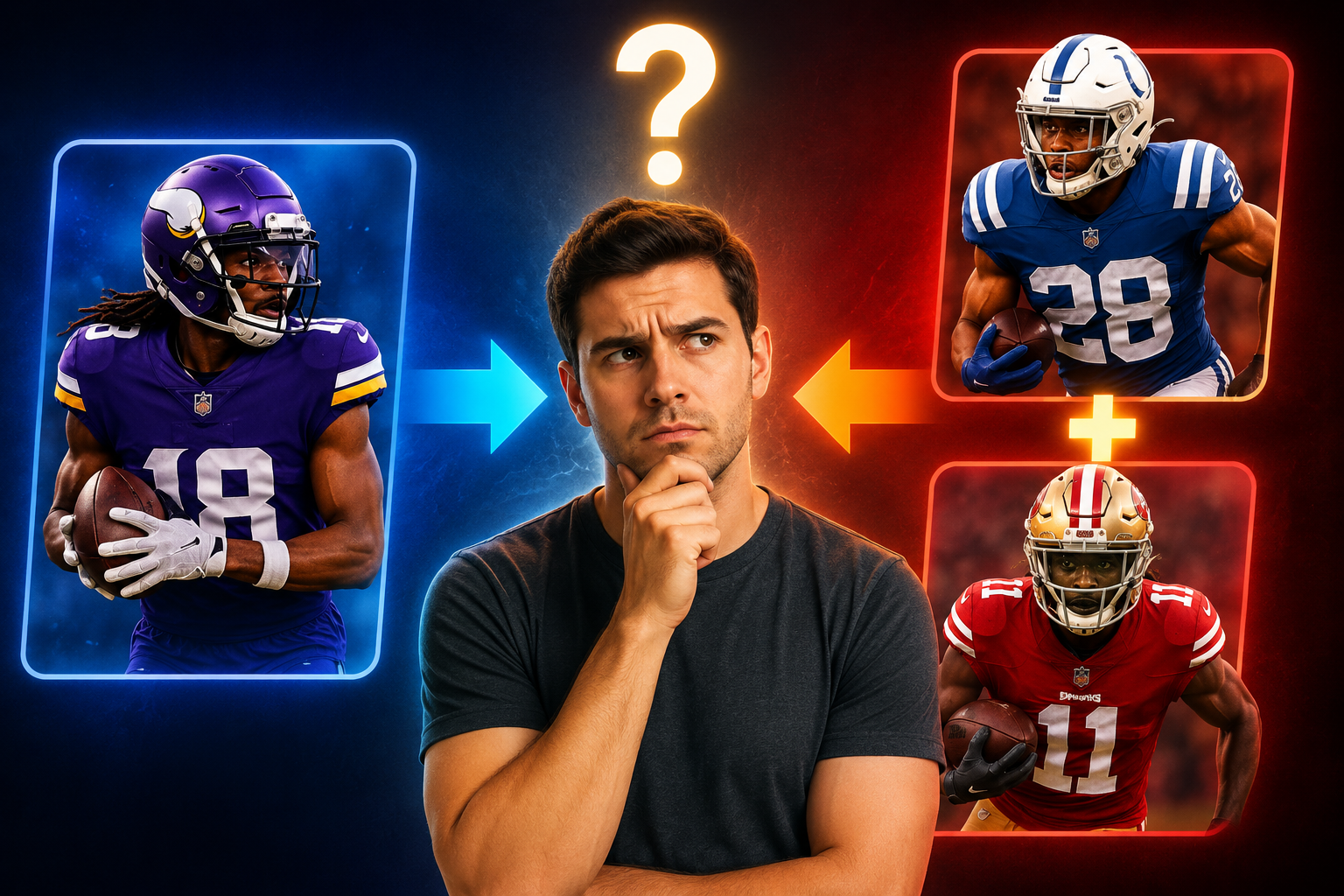
A fantasy trade can look fair at first glance. Both teams may give up players with similar values. A trade calculator may even show almost the same number on both sides. Yet, one team can still come out far ahead.
This happens because fantasy value is not only about numbers. A player’s value depends on your roster, your league rules, your starting lineup, and your goals for the season. A deal that helps one team may hurt another team badly.
That is why a trade can be fair on paper but poor for your team in real life.
The Problem With Trade Calculators
Trade calculators are useful tools. They give managers a quick way to compare players and packages. They can help show if a deal is far from equal.
The problem starts when managers treat the final number as the full answer.
Imagine you have an elite wide receiver worth 90 points. Another manager offers two players worth 55 and 35 points. On paper, the math looks simple.
90 = 55 + 35.
The two sides have the same total value. It seems like a fair deal.
But fantasy football does not give you points for the value of players who sit on your bench. You only get the benefit of the players who make your starting lineup. If the 55-point player becomes your starter but the 35-point player stays on your bench, the trade may not improve your team at all.
You gave up one great player for two useful players, but only one may help you each week.
One Great Player Can Matter More
Player tiers are one of the biggest reasons a fair trade can be a bad deal.
There is a major difference between an elite player and a good player. The elite player may give you a clear advantage at his position every week. A good player may have a similar long-term value but offer less of a weekly edge.
Suppose your elite wide receiver scores 20 points in a week while the average starter at the position scores 13. That player gives you a seven-point advantage.
Now suppose you trade him for two players who each have solid value. One scores 14 points and the other scores 12. Their combined value may look better, but you cannot start both players if you already have enough depth at their positions.
The trade can make your bench stronger while making your starting lineup weaker.
In fantasy football, that is often a losing deal.
Your Starting Lineup Comes First
The best way to judge a trade is to look at your team before and after the deal.
Ask what your lineup looks like today. Then remove the players you would trade and add the players you would receive. Compare the two lineups.
This simple test can reveal problems that a calculator misses.
A trade should help you place better players into your starting spots. If the new players only add more depth, their value may not mean much for your weekly results.
Depth still has value, of course. Injuries happen. Bye weeks create problems. A deep bench can protect your team during the season. But depth should not come at the cost of a major drop in your starting lineup unless there is a good reason for it.
Position Matters More Than It Seems
Not every position has the same level of scarcity.
Two players can have similar trade values while having very different effects on your roster. A strong running back may be much harder to replace than a similar wide receiver, depending on your league.
The same can be true at tight end. If only a few players at the position provide strong weekly numbers, having one of them can give you a major advantage.
This is why a simple player-for-player comparison can miss the real value of a deal.
Your question should not be, “Are these players worth the same?”
Instead, ask, “How hard will it be for me to replace this player?”
If the answer is “very hard,” then his true value to your team may be higher than his trade calculator value.
The Two-for-One Trap
Two-for-one trades often look attractive.
You give up one player and receive two. Your team gets more names, more depth, and more options. It can feel like you are getting extra value for free.
But roster spots have value too.
If you trade an elite player for two good players, one of those players may push another useful player onto your bench. You have more talent on paper but not necessarily more production in your lineup.
This is the hidden cost of the two-for-one deal.
The question is not how many players you receive. The question is how many of those players make your team better.
A great starter can be more useful than two players who only offer small improvements over the options you already have.
Your Roster Changes Player Value
A player’s value is not the same for every fantasy team.
Imagine one manager has three strong wide receivers but needs help at running back. Another manager has weak wide receivers but several good running backs.
The same wide receiver can have a completely different value to those two teams.
For the first manager, trading that receiver may make sense if the return fixes a major weakness. For the second manager, that receiver may be one of the most important players on the roster.
This is why roster fit matters so much.
A player can have high market value but low value to your team. Another player can have a lower market value but solve a problem that has hurt you all season.
Your Goal Also Changes the Deal
Your fantasy goal matters when you judge a trade.
A team that looks like a championship contender should usually care more about current production. A rebuilding dynasty team may prefer younger players, draft picks, or future value.
The same veteran can have very different value for those two teams.
For a contender, an older star who can produce right now may be extremely useful. For a rebuilding team, that same player may not fit the team’s timeline.
This means there is no single trade value that works for every roster.
Current Value and Future Value Are Different
Another common mistake is to focus only on what a player is worth today.
A player’s current trade price may not match his expected future production. A recent breakout may have a very high market value because managers are excited about him. Another player may have a lower price despite strong projected results.
Smart managers look at both sides.
Current value tells you what the player can cost in a trade today. Projected value tells you what you may receive from him later.
Neither number should control the entire decision.
The Real Test of a Fair Trade
A fair trade should not only look equal on a calculator. It should make sense for both rosters.
Before you accept a deal, compare your starting lineup before and after it. Look at positional depth. Think about replacement value. Check whether the players fit your team’s goals.
Then ask the most important question:
Will this trade help me win more games?
That question cuts through much of the noise.
A deal can be 90 for 90 and still hurt your team. If you trade a 90-point star for players worth 55 and 35, the math says the sides are equal. But if only one of those players improves your lineup, the real value may be much lower.
Fantasy football is not played on a spreadsheet. It is played with the players you put into your lineup each week.
That is why the best trade is not always the one with equal numbers. It is the one that gives your team a better chance to win.
ALSO READ: What Went Wrong With Dream11? The Full Story in 2026