








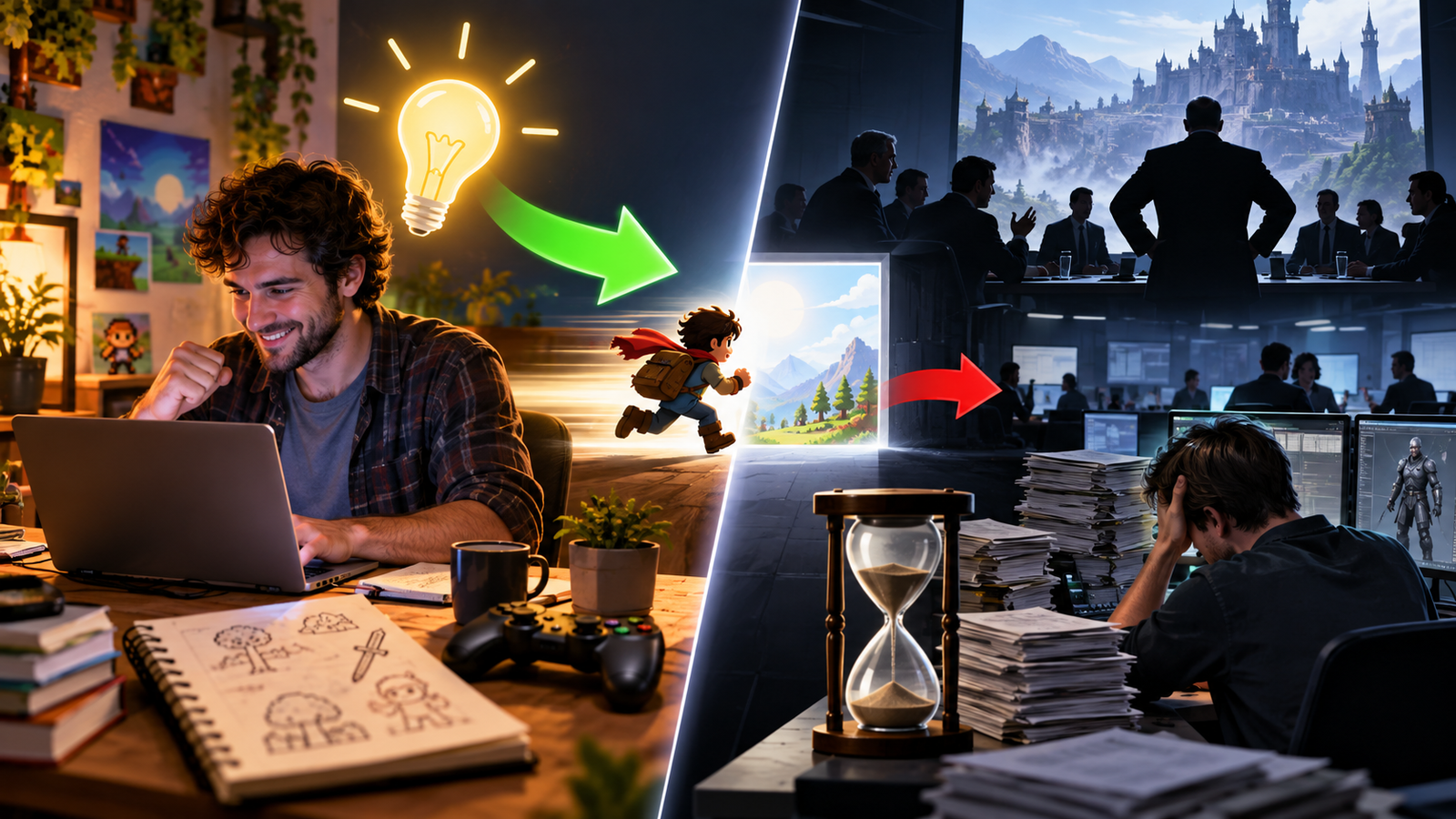
Indie games often reach the market faster than AAA games, even when both start with a strong idea. This does not mean indie developers always have better ideas. In many cases, the real difference comes from how each team turns an idea into a real game.
AAA studios work with large budgets, large teams, many departments, and high business risk. Indie teams often work with far fewer people and much less money. That may sound like a weakness, but it can become a major advantage.
A small team can make a choice fast, test it, change it, and move forward. A large studio may need several meetings and approvals before it can make the same choice. This gap can become very important when the market changes fast.
Small Teams Can Move Faster
One of the biggest strengths of indie studios is their size. An indie team may have only 5–20 people. With such a small group, communication can stay simple. The person who creates a game mechanic may sit close to the person who builds it.
If the team has a new idea on Monday, it may have a basic prototype by Friday. The team does not need to pass the idea through many levels of management. Everyone can see the same goal and make decisions around it.
A AAA studio works in a very different way. A major game can involve hundreds of developers. It may have separate teams for art, design, code, sound, animation, quality assurance, production, marketing, and other areas.
This scale helps a studio create huge games, but it also creates more steps. One small change can affect many other parts of the project. As a result, speed becomes harder to maintain.
Indies Can Take Bigger Creative Risks
AAA publishers usually spend a huge amount of money on their games. Because the cost is so high, they need to feel confident that a game has a large audience.
This often leads to familiar ideas. A known franchise, popular genre, or proven game system feels safer than a strange new concept. A publisher may ask whether a new idea can attract millions of players before it gives the project a large budget.
Indie developers do not always face the same pressure. They can take a small idea and see if players enjoy it.
This gives them room to make unusual games. A simple concept that sounds strange in a meeting can become a great game once people play it.
Games such as Balatro, Vampire Survivors, Among Us, and Papers, Please show the power of this approach. Each game has a clear central idea, yet none needed the scale of a major AAA production to make its mark.
A Strong Idea Can Matter More Than Size
Large games often try to offer a huge amount of content. They may have large maps, detailed graphics, long stories, many characters, side activities, and complex systems.
That scale can create an impressive experience, but more content does not always mean a better idea.
Indie teams often have to work with limits. They may not have enough money or staff for a huge world. Instead, they may focus on one strong idea and make that idea as good as possible.
This limit can help the game feel clear. Players understand what makes the game special. They do not have to spend hours before they find the main reason to care.
A small game with one excellent idea can therefore attract more attention than a large game with many average ideas.
Early Player Feedback Changes Everything
Another major advantage comes from early feedback.
Indie developers often show players a prototype, demo, or Early Access version before the full game is complete. This gives them a chance to see what works and what does not.
If players love one part of the game, the team can give that part more attention. If players ignore another feature, the team can remove it or change it.
This creates a useful cycle. The developers make a small version, players react, and the team uses that reaction to improve the next version.
AAA studios can also use player tests, but their process is often much more controlled. A large project may already have years of work behind it before a broad audience gets a chance to play it.
By that point, major changes can become expensive.
Time Can Change the Market
A game may take years to make. During that time, player tastes can change, new games can appear, and new technology can alter the market.
This creates a major risk for AAA projects.
A studio may start work on a game because a certain genre is popular. Several years later, that genre may no longer have the same appeal. The studio may still need to finish the project because too much money and time have already gone into it.
An indie team can sometimes move from concept to launch much faster. It may find an opportunity while that opportunity still has value.
This is one reason speed matters so much. Being first is not always important, but reaching players while interest is high can make a huge difference.
AAA Studios Have More Talent, but Less Freedom
There is an important point that often gets missed in this debate.
AAA studios are not short on talent. In fact, they often have some of the best artists, writers, designers, engineers, and producers in the world.
The problem is not talent. The problem is structure.
A designer at a large studio may see a great new idea and believe it could improve the game. But that idea may affect art, code, schedules, budgets, testing, marketing, and other teams.
The idea may be good, but the cost of acting on it may be too high.
An indie developer has fewer layers between an idea and the final product. That freedom can be more valuable than a large budget when the goal is to test a new concept.
The Cost of Failure Is Different
Risk also plays a major role.
If an indie game fails, the financial loss may still hurt badly, but the total cost can be far lower than the cost of a failed AAA title.
A blockbuster game may require years of work and hundreds of developers. Its publisher may expect very large sales because the project needs to recover a huge investment.
That pressure can make companies more careful.
Indie developers can often afford to test smaller ideas. They can make a short prototype instead of a massive production. If the idea fails, they can move to another concept without losing the same level of investment.
This does not make failure easy. It simply makes experimentation more possible.
The Real Advantage Is the Idea-to-Market Loop
The biggest difference between indie and AAA development may be the path from an idea to a finished product.
A typical AAA project can move through pitch, funding, greenlight, pre-production, production, integration, quality assurance, certification, marketing, and launch.
An indie project can sometimes follow a much shorter path: idea, prototype, players, changes, and launch.
That shorter cycle lets indie developers learn from the market sooner.
The important point is not that one model is always better. AAA studios can create experiences that small teams simply cannot match. Large teams can build huge worlds, advanced technology, detailed visuals, and complex systems.
But when the goal is to discover a fresh idea and get it into players’ hands quickly, a small team has a natural advantage.
Why This Matters for the Future
The success of indie games shows that players do not always choose the game with the biggest budget. They often choose the game with the clearest reason to play.
A game does not need hundreds of characters, a massive map, or years of production to create a strong connection with its audience.
Sometimes, one smart idea is enough.
That is why indie games can beat AAA ideas to market. They can make decisions faster, test ideas earlier, accept more creative risk, and change course before too much money is locked into one direction.
The deeper lesson goes beyond games. Small teams often have an advantage when speed, experimentation, and clear ideas matter more than scale.
AAA studios may have more resources, but indie teams can have something just as valuable: the freedom to discover what players want while larger companies are still deciding what they are allowed to build.
ALSO READ: 10 Best Female Tag Teams in WWE History