








Technology has come a long way in a short time. A few years ago, a smartwatch was mainly a small device on the wrist. It could count steps, show messages, track heart rate, and help people stay active. Today, these devices can collect far more information about our daily lives.
The next big step may go beyond watches, rings, and smart glasses. It may lead to a world where software can create a digital model of a person, machine, building, or even an entire city. This model is known as a digital twin.
The idea is simple. A real thing exists in the physical world, while its digital twin exists in software. Data from the real world keeps the digital version close to reality. Artificial intelligence can then study that data, find patterns, and help predict what may happen next.
This change can take technology from a simple question such as “What is happening?” to a much more useful one: “What is likely to happen next?”
Wearables: The First Step
Wearables are one of the first major steps toward this future. Smartwatches, fitness bands, smart rings, and other devices can collect information about the human body and daily habits.
A modern wearable may track heart rate, sleep, movement, exercise, location, and other signals. Some devices can also notice changes from a person’s usual pattern.
At first, this data had a simple purpose. A watch could tell someone how many steps they took or how fast their heart beat. Now, the value of the data is much greater. A device can help a person understand patterns across days, weeks, and months.
This creates a basic digital picture of the user. It is not yet a full digital twin, but it is an important part of the path toward one.
From Devices to Ambient Computing
The next stage may reduce our need to interact with a device directly. This idea is often called ambient computing.
Instead of one watch or phone doing all the work, many systems could work together. Sensors in homes, cars, offices, hospitals, factories, and public spaces could collect information about what happens around us.
For example, a smart home could understand when people are at home, how they use different rooms, and how the temperature changes during the day. A vehicle could use information about the driver, road, weather, and traffic. A factory could collect data from machines across an entire production line.
The important change is that technology becomes more aware of its surroundings. The device itself becomes less important. The system becomes more important.
What Is a Digital Twin?
A digital twin is a digital model of something that exists in the real world. It can represent a machine, building, factory, vehicle, city, process, or person.
A digital twin is more than a picture or a 3D model. It uses real data to create a useful representation of the real thing.
Imagine a factory with hundreds of machines. Each machine has sensors that send data to a digital model. The software can show the current state of the factory and help engineers understand how one change could affect the whole system.
The same idea can apply to people. A personal digital twin could use health data, activity, habits, preferences, and other information to create a digital model of an individual.
Such a system would not be a perfect copy of a human. Instead, it would be a useful computer model that could help with decisions.
From Measurement to Prediction
This is where the idea becomes much more powerful.
A wearable today may tell you that your heart rate is higher than normal. That is useful, but it is still a simple form of measurement.
A more advanced system could compare that result with your normal pattern, recent sleep, physical activity, and other available information. It could then explain that the change may have several possible causes.
The important shift is from measurement to interpretation and prediction.
Instead of only telling us what has happened, technology could help us understand why something may have happened and what could happen next.
This does not mean that AI will always be correct. Predictions can fail, especially when the available data is poor or incomplete. Still, better models and better data could make these systems more useful over time.
Digital Twins and AI Agents
The next stage could connect digital twins with AI agents.
An AI agent does more than answer a question. It can assess information, make a plan, and take action within the limits given to it.
A digital twin could act as a safe space for an AI agent to test possible decisions before a real-world action takes place.
Consider a smart factory. Before a company changes the speed of one machine, its digital twin could simulate the effect of that change on the rest of the production line. The company could see possible problems before it makes the physical change.
A city could use a similar model to study traffic changes. A healthcare system could use models to compare possible care paths. A company could test how a change in its operations might affect costs, time, and output.
This creates a new path: the real world sends data to the digital twin, the digital twin helps simulate possible outcomes, and an AI agent can use those results to support action.
The Move Toward Autonomous Systems
This could lead to a much bigger change. Today, people often use technology as a tool. In the future, connected systems may take a more active role.
A smart building could adjust energy use based on conditions inside and outside the building. A factory could spot a possible machine problem before a major failure. A transport system could change routes when traffic conditions change.
In such cases, the goal is not just to collect data. The goal is to use data to improve the real world.
This could create a future where digital systems and physical systems work as one connected system. The digital side observes the physical side, tests possible choices, and helps decide what should happen next.
Privacy Becomes a Bigger Issue
This future also creates serious questions.
A digital twin of a person could contain a large amount of personal information. It could know about health, habits, movement, preferences, routines, and daily behavior.
Who owns that data? Who can access it? How long should companies keep it? What happens if the model makes a wrong prediction? Can a person delete their digital twin?
These questions will become more important as technology becomes more powerful.
Privacy will not be the only concern. Security, consent, data ownership, accuracy, and the right to disconnect will also matter. A system that knows a great deal about a person must have strong rules around its use.
What Comes After Wearables?
The future may not be about replacing wearables with digital twins. Instead, wearables may become one source of data for a much larger system.
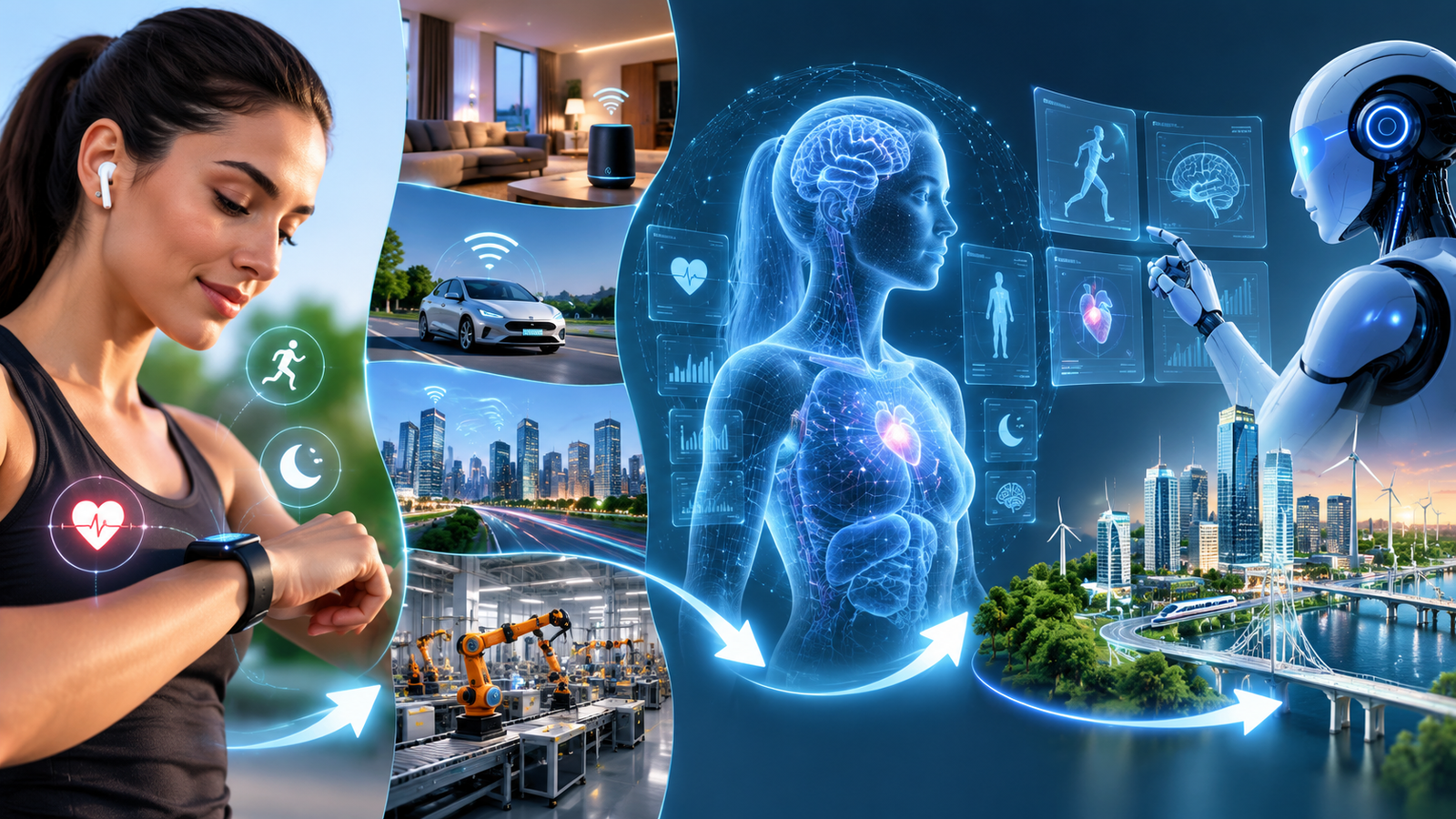
The path could look like this: wearables measure a person, ambient computing understands the surrounding environment, digital twins create a model, predictive AI looks at what may happen next, and AI agents use that information to support or take action.
This represents a shift from “Measure me” to “Understand my environment,” then to “Model me or my system.” After that comes “Anticipate what happens next” and finally “Act on my behalf.”
The final stage could be a group of connected systems that can help optimize parts of the real world with less direct human control.
Conclusion
The journey from wearables to digital twins is not simply a story about better gadgets. It is a change in how technology may understand people, machines, and the world around them.
Wearables gave computers more information about us. Sensors and connected devices can give them more information about our surroundings. Digital twins can turn that information into useful models. AI can then use those models to predict possible outcomes and support better decisions.
The real goal is not to create a perfect virtual copy of a person or place. It is to build a digital model that is useful enough to help people make better choices in the physical world.
If this future arrives at scale, the biggest change may be simple: technology will move from devices we use to intelligent systems that understand, predict, and sometimes act.
ALSO READ: Why Your Rest Days Still Need a Strategy THE SPORTS CENTRAL